WHISTLER by Ann Patchett: An Old Master Working at the Height of Her Powers (Book Review)
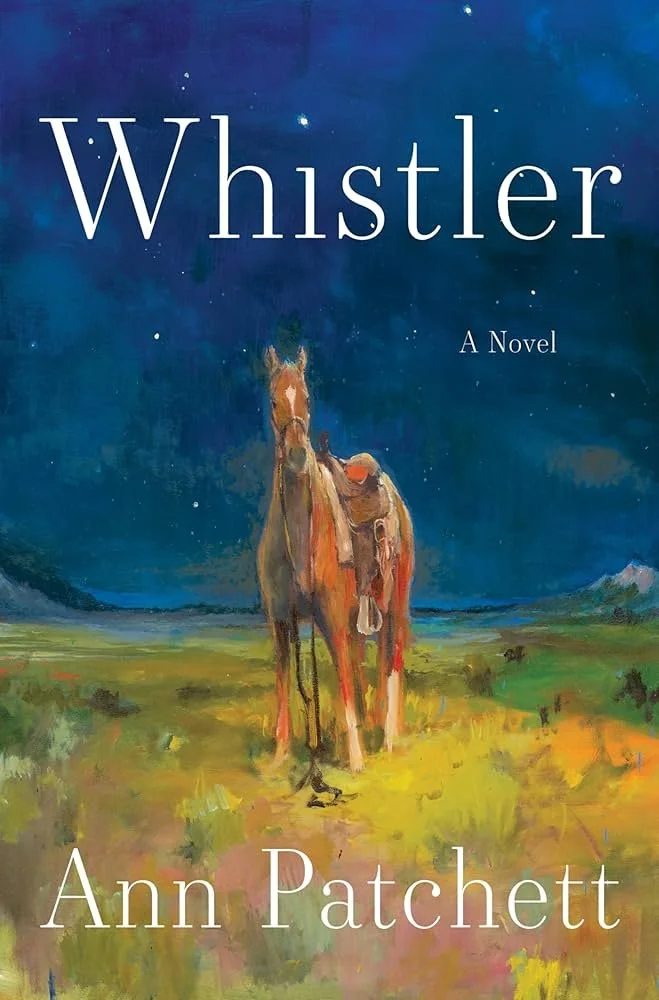
I have been reading Ann Patchett for two decades now. I have enjoyed The Patron Saint of Liars, Bel Canto, Commonwealth, The Dutch House and Tom Lake. I came to Whistler already convinced that she is one of the finest novelists working in English today. This new book, her tenth, does nothing to disturb that opinion. If anything, it deepens it. I loved the rich characters and the imaginative plot. It is a page turner and I consumed the novel in one sitting.
The critical establishment agrees with my sentiments. Kirkus called Whistler “a novel overflowing with rewards for all.” The Boston Globe went further, calling it “majestic and intimate” and “her best novel yet.” The New York Times praised “its generous worldview.” NPR reiterated that Patchett may be “the most beloved book person in America” and the Washington Post called it “the loveliest of summer gifts.” For me, the joy of Patchett’s work is based on her ability to always pass one simple test- Is she readable? The answer is always YES! Patchett’s prose is elegant without being showy and lean without being cold. She never makes you work to admire a sentence. The plainness of her language is deceptive because it seems so effortless and natural, almost easy. She is actually a master craftsman because you read her the way you would listen to a friend or family member tell you something important. You focus on the content and not the technique or delivery. Patchett doesn’t bash you over the head with her sentences, but there is no question she works hard on her novels. She doesn’t announce herself with flashy or gimmicky people or narratives. Instead, she sticks to the basics- the qualities that make us human.
Her understated writing technique is always in service of characters who are the pulsating engine of her fiction. Whistler give us a particularly rich cast. At its center is Daphne Fuller, fifty three, a Manhattan high school teacher who is happily married to Jonathan, a hospital administrator. Patchett paints Jonathan with real affection. He is likable, decent and steady. Daphne’s mother Abigail, a former publicist at a publishing house has been married three times. Abigail is a load, loving but demanding. Her first husband, Buddy Zabriskie is Daphne’s biological father. He is a deep sea fisherman who abandoned the family when Daphne was very young and he could easily have been presented as a caricature of parental failure and a source of angst for Daphne. Patchett goes in another direction. The backstory reveals that Buddy is good man who eventually found his way back to Daphne and became someone she could rely on in times of crisis. Patchett does this better than almost every writer I know- not allowing a character calcify into a stereotype. Abigail’s second husband is Eddie Triplett, a gay book editor who became Daphne’s stepfather. He is the novel’s other foundational pole. He reconnects with Daphne after not seeing her for 44 years. The third husband is Lucas Dekker, a self help author who gets a more distant and formal treatment, but even he isn’t dismissed entirely. Surrounding this core group of characters, we have Daphne’s sister Leda, her husband Steve, their son Henry, and Scott and Polly, two longtime friends of Eddie. Each character contributes to the richness of the story.
The most enduring feature of a Patchett novel is in abundance here. She is warm-hearted toward nearly every character she creates. She is not a hater. Her people are imperfect, sometimes selfish, often blind to their own motives, but they are always trying under difficult circumstances to do right by the people they love. There are no villains in Whistler. The Eddie-Daphne relationship is the heart to the novel and it is where Patchett’s gift for unpredictable narratives shows itself most vividly. The two meet by accident while touring an art exhibit at the Met. They have not seen each other for 44 years- a divide caused by Abigail’s rather abrupt divorce from Eddie. The novel moves between the present day reconnection and flashbacks to their bond during the 4 years when Eddie was stepfather. The revival of their relationship is glorious. She learns Eddie is gay and that he had a long time intimate relationship with one of his college roommates. Eddie draws an affectionate and warm portrait of Abigail and Daphne now sees her mother in a new light. Unfortunately, Eddie has cancer and Daphne effortlessly steps into the role as his caregiver. Eddie becomes an indispensable part of Daphne’s life and self definition. The complementary part of the narrative is the buried past, the near fatal car accident involving Eddie and Daphne when she was 9 yers old. The crash and its aftermath precipitated Abigail’s divorce from Eddie. We hear the story Eddie told Daphne as they waited for rescue, trapped and freezing in the car after that accident. It is a tale about a horse named Whistler which gives the novel its title and central image. We gradually learn how Daphne actually saved Eddie’s life and how she eventually chose to live a life based on the values embodied in the story Eddie told her that day. She learned to face fear and uncertainty with resolve and steadiness and she carried those qualities with her the next 44 years. I won’t go any further in revealing the nuances of Patchett’s plot lines; I don’t want to undermine the steady stream of surprises.
A fun fact about Ann Patchett is that she is the co-owner of Parnassus Books in Nashville and one of the most visible and effective advocates for independent bookstores and emerging American writers. She has a duel identity as an award winning novelist and a tireless advocate for the books of others. Patchett’s advocacy for literacy isn’t separate from her own fiction. She loves books and really seems to love her own characters.
Whistler ultimately is a novel about intimacy. It highlights how unpredictable and unforeseeable relationships may create durable lifelong bonds. Here, the characters are not necessarily connected by blood or marriage. We have families and stepfamilies. We have gays and straights. The novel is warm, beautifully constructed and genuinely moving. It has depth and an unblinking honesty. It doesn’t bleed into easy sentimentality. That is the difference for me between Whistler and Theo of Golden which trades in a similar warmth but lacks the same weight, nuance or complexity. Ann Patchett is a superstar.