Ten families and ten essays later, I want to end this commentary with my favourite blog topic - books. Our “special” Roman families of the Renaissance and the Baroque eras inspired an enormous body of literature. There is a wide range of serious scholarship, well researched biographies and entertaining historical fiction. It is beyond the scope of this blog to publish a comprehensive bibliography. Instead, I offer a personal recommended reading list of ten books. My criteria is simple: I have read the book and they satisfied my respect for a combination of scholarship and readability. Do they make the past come alive for the contemporary reader? Please accept my good faith effort to introduce works that cover the the major noble families, the supporting cast of great artists and the broader cultural and political world of the Renaissance. All are a good investment of your reading time before your next visit to the Eternal City.
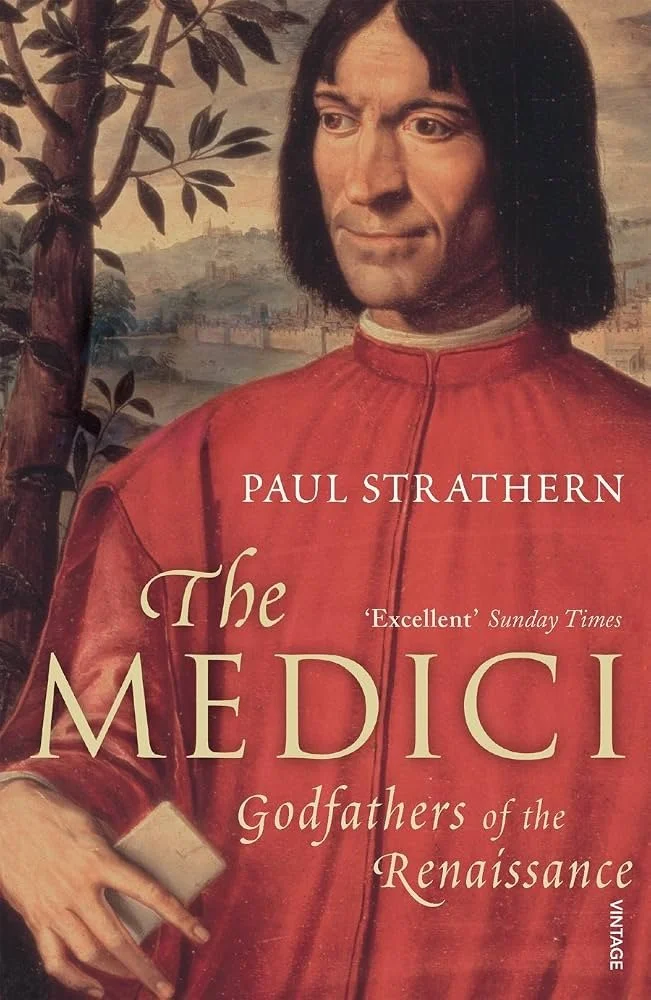
1. THE MEDICI:GODFATHERS OF THE RENAISSANCE by Paul Strathern (2003)
This is the single best popular history of any family in the series. Strathern is a rigorous scholar with a novelist’s flair for narrative- a rare combination. He covers the full arc of the Medici- from Giovanni’s founding of the bank through Cosimo, Lorenzo and the two Medici Popes who presided over the Renaissance’s glittering peak and its catastrophic collapse. The chapters on Leo X and Clement VII are particularly excellent. If you only read one book on this list, read this one.
2. MICHELANGELO AND THE POPE’S CEILING by Ross King (2003)
The story of the Sistine Chapel commission is a gripping narrative history. King puts Julius II, Michelangelo, Raphael and Bramante in Rome simultaneously and they are all operating at the height of their powers. The relationship between Julius and Michelangelo is delivered with psychological acuity as we witness the Warrior Pope bullying the greatest artist of the age. Essential reading and the basis for much of my delle Rovere essay.
3. CARAVAGGIO: A LIFE SACRED AND PROFANE by Andrew Graham Dixon (2010)
The definitive Caravaggio biography is one of the best art- historical books of the past 30 years. Graham Dixon puts the paintings in the locales they were made- the taverns, the brothels, the churches of Counter- Reformation Rome- and the result is a vivid and multilayered portrait of an artist’s life and his social world. His treatment of Caravaggio’s relationship with the Colonna who sheltered him after this fatal duel in 1606 and with the Scipione Borghese who built a collection anchored by Caravaggio’s early works gives my series a biographical thread running from the 5th essay through the 10th. The paintings referenced in my essays will look different after you read this book.
4. BERNINI: HIS LIFE AND HIS ROME by Franco Mormando (2011)
Bernini worked for seven Popes across six decades and his output shaped the physical appearance of Rome more than any single artist, before or since. Mormando covers the full arc of his amazing career with biographical detail and dry wit. Reading this book with my Barberini, Pamphilj, Chigi and Borghese essays give the series a unifying artistic thread. Bernini is a constant presence in the story of volatile Papacies that were the driving force of the age.
5. JULIUS II: THE WARRIOR POPE by Christine Shaw (1993)
The authoritative biography of the della Rovere Pope who commissioned the Sistine ceiling, set Raphael to work on the Vatican Stanze, demolished the old St Peter’s and began the new one and simultaneously commanded armies fighting to consolidate the Papal States. Shaw is a scholar writing for a general audience and she fulfills her charge superbly. The politics of the Italian Peninsula in the early 16th century are intricate and confusing and she explains them with admirable clarity. Julius is one of the most extraordinary figures in my series- a larger than life persona who deserved his own book. This is it!
6.BLOOD AND BEAUTY by Sarah Dunant (2013)
The best historical fiction on the notorious Borgia family. Dunant researched the era with scholarly rigour and her portrayals of Alexander VI, Cesare and Lucrezia are more nuanced than the television adaptation. The novel covers the Borgias at the height of their power. We are eyewitnesses to Alexander’s Papacy, Cesare’s military campaigns and Lucrezia’s serial marriages. Dunant writes with a political intelligence that neither condemns the family or excuses them. The follow up novel- In the Name of the Family covers the Borgia collapse and Machiavelli as an acolyte in Cesare’s court. I recommend you read them in sequence.
7. THE FAMILIES WHO MADE ROME by Anthony Majaniahti (2005)
The most practically useful book on this list and the one most directly complementary to this series. Majaniahti covers nine major family dynasties with a format that pairs historical narrative with specific sites and practical visitor information. Each chapter tells the family story and walk you through the neighbourhoods and buildings they left behind. The Colonna, Orsini, Farnese and Borghese family chapters are particularly strong and the treatment of the medieval baronial families gives context through the blood feud that runs through the fifth and sixth essays in the series. Carry it in your bag when you walk Rome. It is the best art- historical guidebook in print.
8. SAINTS ANS SINNERS: A HISTORY OF THE POPES by Eamon Duffy (1997)
The best single volume history of the papacy from Peter to the present. It was written by a Cambridge historian with the rare ability to be scholarly, readable and user friendly for a general audience. The Renaissance chapters on della Rovere, Borgia, Farnese and Medici provide essential institutional context for everything in our series. Understanding the Papacy as an institution made the families behaviour comprehensible if no lass scandalous.
9. THE PRINCE by Niccolo Machiavelli (1512)
The ultimate political text that emerged directly from the Renaissance world described in the series. Machiavelli wrote his classic in the aftermath of the Medici restoration, drawing on first hand observations of Cesare Borgia’s campaigns in Romagna. Every family in this series either exemplified or suffered form the “real politic” principles articulated by Machiavelli. The George Bull Penguin translation is clean and accessible.
10. BASILICA: THE SPLENDOR AND THE SCANDAL OF BUILDING ST PETER’S by R.A Scotti (2006)
It is story of the construction of St Peter’s - a project that consumed 120 years, 20 Popes, and the financial scandals that triggered the Protestant Reformation. Julius II della Rovere ordered the demolition of the old basilica, Paul III Farnese kept the construction alive during the counter - reformation and Paul V Borghese completed Maderno’s facade. The building’s architectural history is a mirror on the family histories portrayed in my essays and Scotti tells it with pace and clarity.
There are two original source works that I have not included here because I have not read them. However, academics and serious students of the Renaissance recommend them highly. I will plug them in here as “Honorable Mentions” and pledge to personally read them this fall in Rome. The first is Lives of the Artists by Giorgio Vasari (1550). The second is Autobiography by Benvenuto Cellini (1558).