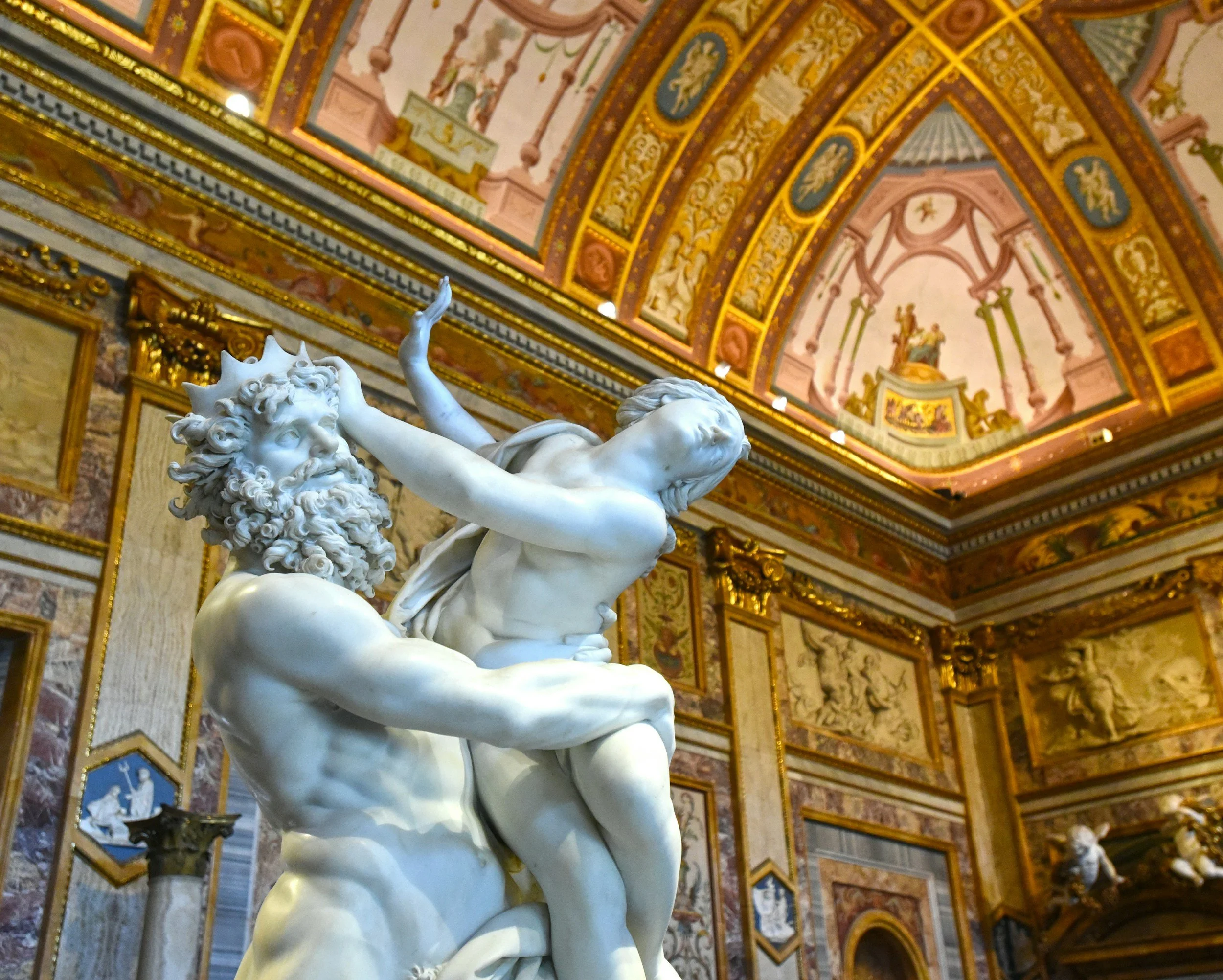
The Galleria Borghese requires advance booking, limits visitors to two hour time slots and turns away anyone who arrives without a reservation. This is annoying, but entirely justified. The gallery contains Bernini’s Apollo and Daphne, his David, the Rape of Proserpine and his Aeneas and Anchises- four of the greatest sculptures ever. Bernini produced them before the age of 25. The museum also contains six Caravaggio paintings, including the Boy with a Basket of Fruit and the Sick Bacchus. It features Raphael’s Deposition and Titian’s Sacred and Profane Love. It is, in the assessment of most serious observers, the single greatest collection of Renaissance and Baroque art per square meter on earth. It was assembled in roughy two decades by one man, Cardinal Scipione Borghese, the nephew of Pope Paul V, who used nepotism, papal leverage, tax confiscation and outright coercion with enthusiasm and unerring aesthetic judgment. We have touched on the collection previously and a closer look at the Borghese dynasty is warranted. They deserve a place on this list of “special” Roman noble families.
The Borghese origin story tracks a path from Siena to Rome and from lawyers to Princes. The Borghese, like the Chigi, came from Siena- a Tuscan family of merchants and civic officials who established themselves in Rome during the 16th century and expanded their influence through discipline, patience and persistence. Marcantonio Borghese moved the family to Rome in 1541, entered papal administrative service and made a strategic second marriage to a Roman noblewoman that planted the family firmly in Rome’s upper social tier. His son Camilo, educated as a canon lawyer in Perugia and Padua, rose steadily through church offices- Nuncio to Spain. Cardinal Vicar of Rome- and was elected Pope Paul V in 1605. He was fifty two, experienced, at the top of his game and entirely focused on how the family could benefit from the Papacy. Within weeks of his selection, he adopted his nephew Scipione Caffarelli, elevated him to Cardinal and installed him as the de facto head of Vatican government. The Borghese embraced the oldest and most sacred rite in Rome- ascend to power and cash in quickly.
Pope Paul V was an activist Pope. He is remembered for two things- being an incredible builder and his aggressive assertion of Papal authority in Italian political matters. He placed the entire Republic of Venice under interdict in 1606- a bold move, probably an abuse of power, that required a lengthy mediation and ultimately undermined the Papacy’s political status in Italy. He transformed Rome’s physical appearance. He completed the facade of St Peter’s Basilica with Carlos Moderna and had his name emblazoned across the entrance in letters two meters tall. He restored the ancient Aqua Traiana aqueduct which still operates today. He built the Borghese chapel in Santa Maria Maggiore which became family’s dynastic mausoleum. Most importantly, he funded his nephew Scipione’s pursuit of the best collection of art in the world.
Scipione Borghese was not a humble or patient fellow. He pursued his art work targets relentlessly. When the painter Cavalier d’ Arpino failed to pay his tax bill in 1607, Pope Paul confiscated the artist’s entire studio- 107 paintings and gave them to Scipione. The haul included early works of Caravaggio which are in the museum today. When Carvaggio’s Madonna and Child with St Anne was rejected by St Peter’s for its earthly realism, Scipione convinced his Uncle to transfer ownership of the the work to the Borghese family private collection. Some historians believe that was the plan all along! After he saw Raphael’s Deposition in Perugia, he had it removed and bought to Rome under the cover of night. The citizens of Perugia threatened revolt but Scipione compensated them with two good copies from his collection. He acted without embarrassment, had great taste and was not weighed down by scruples. Scipione dramatically impacted the development of the Baroque Rome we admire today. He discovered Bernini, mentored him, sponsored him and made him famous- all before Bernini turned 26. Without the Borghese commission, there is no Bernini and without Bernini, the Rome that exists today would not exist. Quite a legacy!
The Borghese had staying power. They maintained their position of prominence in Rome through the 17th and 18th centuries. They acquired land titles aggressively, entered strategic marriages and eventually bonded with the Orsini- a rival dynastic clan. The most dramatic episode involving the family occurred in 1803, when Prince Camilo Borghese married Pauline Bonaparte, Napoleon’s favourite sister. It ended badly. Camilo was weak and ineffectual and Pauline was serially unfaithful. In 1807, Napoleon pressured Camilo to sell 344 pieces of classical sculpture to the Louvre where they remain today. However, Canova’s portrait of Pauline as a reclining Venus- serene, beautiful and magnificently unconcerned with propriety- is still in the Borghese gallery today and is a must see. Finally, in 1902, the Borghese filed for bankruptcy after a series of disastrous investments. The Italian state acquired the villa and the Borghese family gardens became Rome’s largest public park. Amalia and I walk the grounds regularly - along with thousands of tourists and locals. The gallery is in the casino built by Scipione on Pincian Hill between 1613 and 1625 and both the galleria and the park and gardens still bear the Borghese name. It is a civilised and inspirational setting.
The Borghese remain alive in literature and public culture. Simon Schama’s Power of Art devotes an episode to Bernini and the Borghese commission and is an excellent treatment of Baroque sculpture generally. Caravaggio has generated numerous biographies and Andrew Graham Dixon’s Caravaggio; A Life Sacred and Profane (2010) is the most comprehensive and the Borghese role in his career is a central theme. Pauline Bonaparte’s Venus sculpture and the story behind it is referenced in several Napoleon biographies and Stendahl’s Roman journals.
The Borghese are a fitting end to this series. They arrived late when compared to the other families, produced a single Pope rather than a dynasty of them and owe their lasting place in Rome’s story not to political cunning or military victories, but the aesthetic judgment of one Cardinal and the genius of the artists he identified and recognised. Rome today stands on its history of artistic achievement. Italy is a second level power now, but Rome remains unmatched as a center of beauty, artistic and architectural ambition and achievement. There is a permanency to the place and much credit goes to ten families we have chronicled in this series.