In Trastevere, a short walk from the Tiber, stands Villa Farnesina, a splendid Renaissance villa that rarely makes the dance card of short term visitors to Rome. It takes its name from the Farnese family who purchased it in 1577. It is an intimate and beautiful building. Raphael painted the Triumph of Galatea on its walls. The Loggia of Psyche displays ceiling frescoes of interlocking mythological scenes, garlanded with fruit and flowers, that are simply joyful. The fun fact is that the villa was actually built by the Chigi family- a competitor of the Farnese in Roman power circles. It was built between 1506 and 1510 by Agostino Chigi, the richest private individual in Europe- the Rothschild or JP Morgan of the Renaissance. Agostino was not a Pope or a Prince. He was a brilliant banker from Siena who outspent, out built and out patronised every Pope of his era. His family flourished and finally produced a Pope of its own 150 years later.
Siena was the original great banking city of Italy and the Chigi had been active in financial circles there since the 13th century. Agostino was born in 1466 and arrived in Rome in 1487 to work with his father as bankers to the Papacy. Agostino was a natural banker- possessing extraordinary commercial instincts and the ability to identify opportunities and close deals with amazing speed and agility. He secured monopolies on aluminum mines - the essential element in the textile industry and began to realise enormous profits. He controlled salt production in the Papal States and the Kingdom of Naples. He became lead banker to Pope Alexander VI (a Borgia) and Julius II (a Della Rovere) and managed the Vatican’s finances with a brutal efficiency that made him indispensable to these ambitious Popes. By the time Julius II passed away in 1513, Agostino Chigi employed 20,000 people, owned over 100 ships and had banking branches all across Europe. He was the MAN!!
Like many of his famous compatriots, Chigi had interests that extended far beyond the pursuit of wealth. His nickname “Il Magnifico”- copying Lorenzo de Medici - was not accidental. He consciously modeled himself on the Florentine tradition of actively supporting the humanities and the arts. He had the resources to execute he strategy on a scale that not even the Medici could imagine. His parties at Villa Farnesina were the most celebrated entertainments in Renaissance Rome, attended by Popes, Cardinals, ambassadors, poets and artists. He would throw his silver dinner service out the window after a long dinner, showing his disdain for mere material items. Of course, as a shrewd banker, he positioned his servants with nets on the streets below to catch the goodies. His friendship and sponsorship of Raphael is legendary. They were close friends. Peruzzi and Piombo and Sonoma all contributed to the design and decoration of the villa. Standing in those spaces today with their vivid colours and spectacular artistry, you recognise you are experiencing the Renaissance at its finest. Unfortunately, and similar to a pattern we have identified with other noble Roman families, the performance of Agostino’s descendants was uneven. Agostino died in 1520 at 53 and his eldest son proceeded to dissipate much of the family fortune within a generation. The pleasure palace villa passed to the Farnese during the hard times. The Chigi family retreated from the first rank of Roman life, but then proved resilient and rebuilt their reputation and standing patiently over the next century. They focused on the Church rather than banking and accumulated growing influence with a methodical persistence. Finally, they achieved complete redemption with the ascension of Fabio Chigi to the Papacy in 1655.
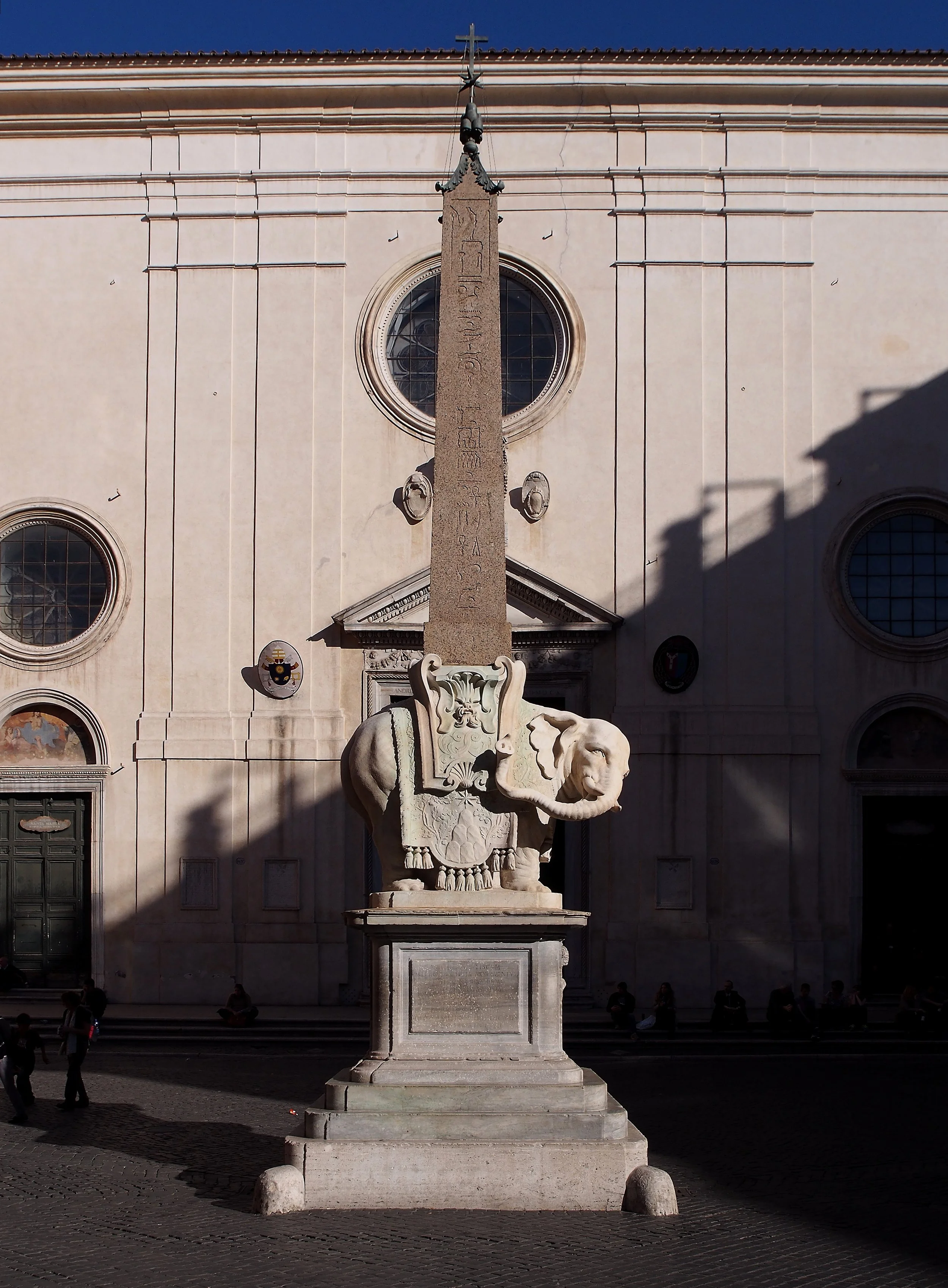
Cardinal Fabio took the name of Pope Alexander VII. He immediately summoned an aging but still motivated Bernini to the Vatican to discuss a new round of building projects. The relationship between Alexander and Bernini rivals that of Bernini and Innocent X a generation earlier. In 12 years, Alexander commissioned the colonnade of Piazza San Pietro, the double elliptical arcade of 284 columns and 88 pilasters that transformed the approach to St Peter’s into a processional embrace. Bernini next completed the Cathedra Petri, the gilded bronze throne of St Peter’s inside the basilica and then Scala Regia, the ceremonial staircase connecting the Vatican Palace to St Peter’s. Three of the defining architectural achievements of Baroque were completed during the reign of the Chigi Pope. Well done! He also commissioned Bernini for a Chigi family vanity project- a small marble elephant in Piazza della Minerva carrying an Egyptian obelisk on its back. The Chigi family herald of mountains and stars stands on the summit of the obelisk. It is one of Rome’s most charming monuments- small, witty and unique- a tribute to the character of the Chigi Pope who commissioned it.
My recommendation for visitors to Rome is to include a stop at Villa Farnesina. It is located on Via della Lungara and is open Monday- Saturday. Check the opening hours in advance. It is one of the most under appreciated historical sites in Rome. You have superior Raphael works all to yourself if you visit on a weekday morning. The building is small, the frescoes are at eye level and the experience is special because of the intimacy. Allow 90 minutes.
Finally, an examination of the Chigi and popular culture and literature. The Culture of the High Renaissance published in 1998 includes a scholarly treatment of the Chigi’s place in the Renaissance. The Vatican and St Peter’s building program and the critical role of Pope Alexander VII is featured in Franco Mormando’s Bernini; His Life and His Rome which is the best modern biography of the master artist and sculptor. The Chigi family palazzo on Via Corso is now the official residence of the Italian Prime Minister and is a reminder that the Chigi family footprint survives in contemporary Rome. Great family and the scandal quotient is less than many of our other Roman noble favourites.