All visitors to Rome ultimately end up at Piazza Navona- a great Baroque elongated square built on the footprint of a Roman chariot racing stadium. Bernini’s Fountain of the Four Rivers stands at its center and Borromini’s Sant’Agnese in Agone towers over its cobblestones. Few realise they are standing at the center of one family’s vanity project. The palazzo, the church, the fountain and the complete transformation of the piazza from a muddy medieval market into one of the supreme examples of Baroque architecture was all commissioned by one man, Pope Innocent X, between 1644 and 1655. Pope Innocent was a Pamphilj and Piazza Navona is a bold example of this distinguished family’s ambition. The family continues to reside in Rome today and they are a sterling example of the staying power of Rome’s elite.
The Pamphilj were not ancient Roman nobility like the Colonna and Orsini or papal merchants like the Barberini. They were a respectable provincial family from Gubbio in Umbria. They established a presence in Rome by the 16th century and gradually climbed the totem pole of power and influence through legal talent, strategic marriage and the patient cultivation of church connections. In that respect, they followed the pathways that characterise so many of the families in this series. By the time Giovanni Battista Pamphilj was born in 1574, the family had built a solid presence in Papal administration without reaching the first rank, Giovanni excelled as a student at the Jesuit Collegio Romano School of Law and then worked his way through the canonical bureaucracy until he became a Cardinal in 1629. When Pope Urban VIII (a Barberini) died in 1644, Giovanni Batista emerged from a 64 day conclave as Pope Innocent X. He was 70 years old.
Innocent’s first priority was dismantling the Barberini legacy. He opened investigations into their financial abuses, drove the Barberini Cardinal nephews into Parisian exile and systematically reversed the policies of his predecessor. Bernini had been a Barberini favourite and he was a major casualty in the early stages of the Pamphijl reign.When Bernini’s bell towers for St Peter’s had to be demolished due to structural instability, Innocent seized the opportunity to sideline Bernini and awarded the new Papal commission to Borromini. Pietro da Cortona’s frescoed ceilings, the long gallery of the Palazzo Pamphilj and the early stages of the Church of Sant’ Agnese are all Borromini creations. He was the “it” guy. The reversal of the artistic and architectural hierarchy in Rome seemed complete. BUT, as was common in Renaissance Rome, a resident Bernini made a comeback- his path eased by the patronage of an extraordinary and dynamic woman.
Donna Olimpia Maidalchini was the widowed sister-in-law of Pope Innocent. She was the the powerful woman in 17th century Rome and arguably in the entire history of the Papacy. She deserved her own Netflix mini series. She managed the Pope’s finances, controlled access to his audiences, dispensed patronage and accumulated wealth with a systematic thoroughness that earned her the nickname “La Papessa” - the she-Pope. She was a secret admirer of Bernini and arranged for a silver model of his proposed Fountain of the Four Rivers to be placed in a location in the Vatican where Innocent could not miss it. Predictably, the Pope was transfixed and declared that “the only way for the works of Cavalier Bernini not to be built was by not seeing them.” Bernini was back! A competing Borromini design was set aside and Bernini got to build his historic fountain. Olimpia’s timely intercession change the course of history.
Piazza Navona became a Pamphilj family monument. The Palazzo was designed by Girolamo Rainaldi and the interior by Borromini. It occupied the entire western flank of the square and became Olympia’s residence and the effective centre of Papal administration. Sant’ Agnese on Agone was the family chapel. Bernini’s fountain portrays four river Gods representing the Danube, the Nile, the Ganges and Rio della Plata. There is a towering Egyptian obelisk topped by the Pamphilj symbol- a dove- which announces the family claim over four continents. The Piazza Navona that thousands of tourists photograph every day is a Pamphilj production and statement. The family also built another family abode on Janiculum Hill- the Villa Doria Pamphilj. It was commissioned in the late 1640’s by Innocent’s nephew and the highlight is a refined Baroque villa that sits at the heart of Rome’s largest outdoor green space. The Villa is now a government conference center and recently hosted a G-20 summit and the surrounding park is open daily. I recommend it - it is a great hike - a vast space, green and natural, with great views and is almost entirely unspoiled by tourists. It has been described as “The lungs of Rome.”
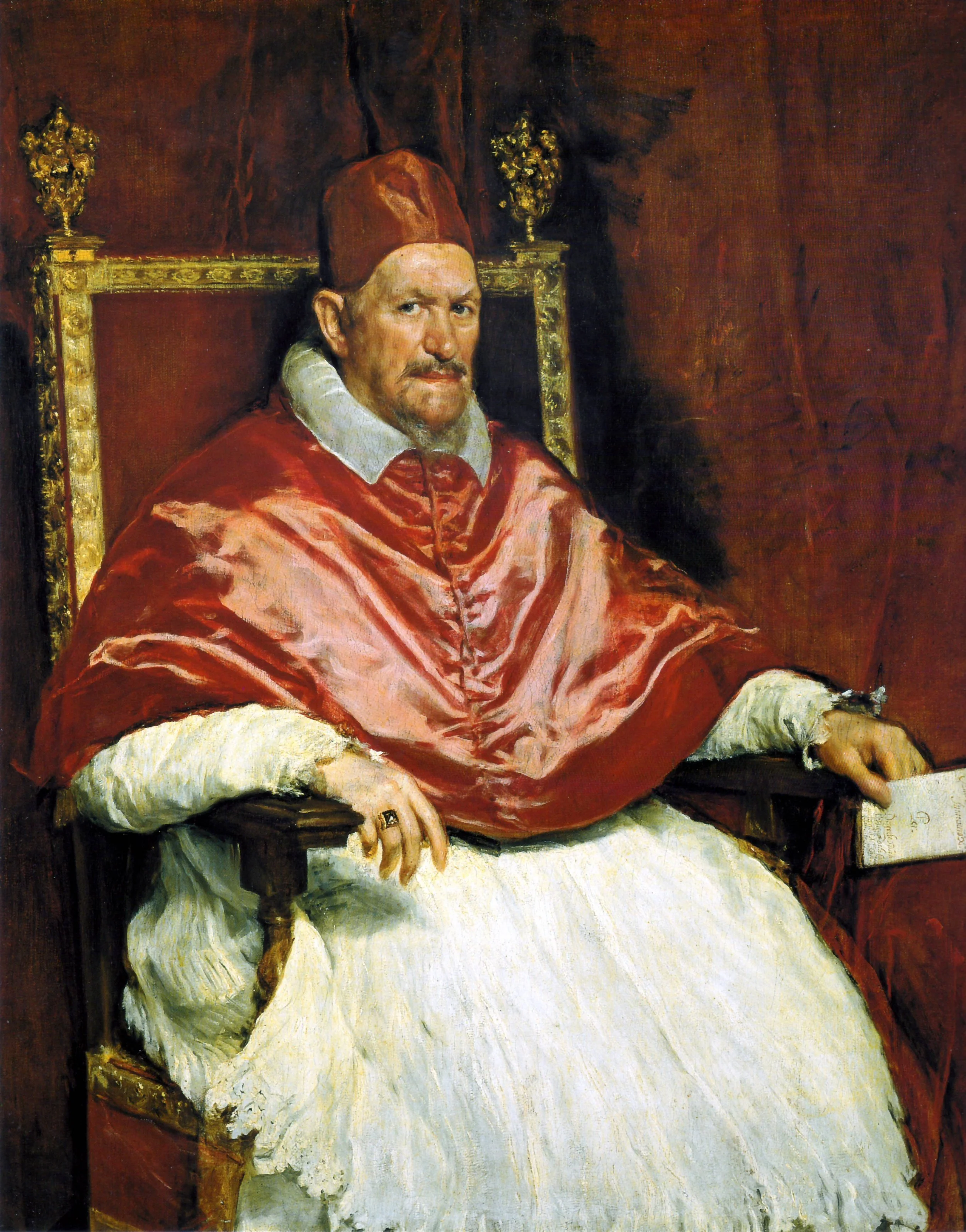
The Pamphilj are also the subject of one of art’s most famous portraits. Diego Velazquez arrived in Rome in 1650 and painted a haunting portrait of Pope Innocent. The Pope was 76, shrewd suspicious and was initially reluctant to sit for the Spanish Master. The portrait was basically a depiction of a confrontation between the artist and his subject. Innocent gazes directly at the viewer with an expression of concentrated intelligence, the red of his vestments blazing against the crimson curtain behind him, a letter in his ringed hand. Velazquez has given him a genuine dignity. When the Pope saw the finished work he reportedly exclaimed “Trope Vero”- too true. The painting has been the face of the Pamphilj family to the world ever since. It hangs today at a third residence associated with the Pamphilj- the Galleria Doria Pamphilj, located on Rome’s greatest shopping street, Via del Corso. The Pamphilj noble line resides there today and it also serves as a museum for the family art collection which has been accumulated over four centuries. It is one of the finest private galleries in Europe and is open for tours at select times. If you are lucky, you may see a Pamphilj entering his custom made Ferrari in the courtyard. WE DID! The Velazquez portrait occupies its own dedicated room, separated from the surrounding collection by a wise curatorial choice. Bernini’s busts of Pope Innocent and the Olimpia are also featured in the galleries. All of the works a depict strong jawed, formidable and seemingly unsentimental people who enjoyed the exercise of power.
The most significant contemporary cultural treatment of Pope Innocent and the Pamphilj is the Franics Bacon’s “Series on the Velazquez Portrait” released in 1953. Bacon never saw the original in Rome and worked from reproductions. He produced quasi disturbing works that graphically distorted the focus original portrait. The seated Pope figure is now screaming, almost dissolving, trapped behind veils of paint. Respected critics view the Bacon series as some of the most psychologically intense paintings of the 20th century. Frankly, I am not sure I understand the message, but it is curious that a contemporary artist would choose to interpret a 17th century Pamphilj Pope. The rivalry between Bernini and Borromini is captured in the 17th century diary of a traveling English globetrotter- John Evelyn. He writes about both architects, Papal intrigue and has a distinct point of view- a sensible and pragmatic Englishman fascinated, bewildered and amazed by the mores of Roman Baroque culture. The Piazza Navona history is the subject of Cesare D’ Onofrio’s Le Fontane di Rome. A good read that makes sense of the modern square that we all love.