The Barberini were not a shy or unassuming group. They were almost Trumpian in their eagerness to place their family name and crest on the face of every important structure in Rome. For exhibit one, I take you to St Peter’s Basilica. At the center of the Church you will gaze up at Bernini’s Baldachin- an enormous bronze canopy 30 meters tall that marks the tomb of St Peter directly beneath the dome. When you look closely at the twisted column, you will identify “bees” crawling up them. Three bees, the Barberini coat of arms are embedded in the most sacred place in Christendom. Pope Urban VIII, the most illustrious Barberini commissioned Bernini to build the Baldachin and instructed him to incorporate the bees into his work. It was a bold and theatrical way to announce the family’s arrival at the summit of power and ensured that the symbol of Barberini would be visible to every person who entered St Peter’s for the rest of time. It worked! The Barberini lasted as a Papal dynasty for only 20 years, but the bees are still there in all their glory.
The Barberini journeyed a path from Tuscan merchants to Roman Princes. Of the noble families in this series, they are the most nakedly self made. They came from Barberino d’Elsa in Tuscany where they were minor wool and cloth traders. They moved to Florence in the 11th century and changed their name form “Tafani”, which means horseflies, to Barberini. The bees on the coat of arms was also an upgrade- same insect family but more elegant. The family moved into the Church’s administrative orbit gradually with Antonio Barberini establishing a foothold in Rome in the mid 16th century. Eventually, he summoned his nephew Francesco and his grand nephew Malfeo to Rome. Malfeo had been educated by the Jesuits in Florence and held a Doctorate in Canon Law. He was a natural bureaucrat and moved up the hierarchy with methodical competence. He became a Cardinal in 1606 and was elected as Pope Urban VIII in 1623.
Pope Urban embraced the Papal tradition of outrageous nepotism. Within a week of his election he made two nephews and his brother Cardinals. A third nephew Taddeo was named the Prince of Palestrina and Commander of the Papal Army. The Barberini three bees appeared on fountains, churches and palaces across Rome with a speed that awed his contemporaries. Urban ran the church with an iron hand, enriched his family and quickly embraced the challenge of redecorating and beautifying the Eternal City. The key was the Pope’s relationship with Bernini.
The bond between Maffeo Barberini and Gian Lorenzo Bernini is the most consequential patron- artist partnership of the 17th century and arguably the most important since Julius II and Michelangelo a century earlier. Urban recognised Bernini’s genius early, pilfered him from the Borghese studios and gave him unprecedented license to execute his artistic vision. Bernini brought the world Roman Baroque. Highlights include the Baldachin in St Peter’s, the Fontana di Tritone in Piazza Barberini and the Palazzo Barberini itself. Bernini did portraits of Urban and his family and they were the foundational commissions that set Bernini on the path to the Piazza Navona fountains, the Piazza San Pietro colonnades and the Ecstasy of Saint Teresa. Pope Urban told Bernini, “You were made for Rome and Rome was made for you.”
Pope Urban invited controversy and made some awful mistakes as his Papacy progressed. The bronze for the Baldachin’s column came from the Pantheon’s ancient portico. On Urban’s order, 927 tons of bronze were removed on the theory that the Pantheon was an ancient pagan temple and the material was better suited to an ascendant Catholic Church. Rome was not amused and a famous lampoon appeared on the ancient speaking statue of Pasquino- “Quod non fecerunt barbari”—what the barbarians did not do the Barberini did! The insult followed the family reputation ever since and I guarantee your guide at the Pantheon tour will mention this episode,
Urban’s papacy contained the seeds of its destruction in his persecution of Galileo and the Castro War. Interestingly, Urban and Galileo had been friends before Urban became Pope. They were intellectually sophisticated Tuscans who ran with the same crowd in Florence. In 1633, after Galileo published his “Dialogue Concerning the Two Chief World Systems”, Urban authorised the Inquisition to try Galileo for heresy. The immediate cause was personal: Urban believed that the character “Simplico”, the dim witted defender of geocentrism in the Dialogue was a caricature of him. The trial forced Galileo to recant his conclusions under the threat of torture. It remains the most damaging episode in the history of the Church’s relationship with science and Urban’s vanity was the proximate cause. The Castro War was the final humiliation for Urban. He unwisely approved a military confrontation with the Farnese Duke of Parma over a petty protocol dispute. The war was an inconclusive standoff and Urban exhausted the Papal treasury in the process. He excommunicated the Duke on a personal pique and totally lost the confidence of the College of Cardinals. By the time he died in 1644, Urban was a beleaguered figure and Rome celebrated his passing. His successor Innocent X immediately opened an investigation into Barberini financial abuses. The Barberini nephews fled to Paris. The family that had assumed power with such boldness in 1623 was exiled from Rome within a year of Pope Urban’s death.
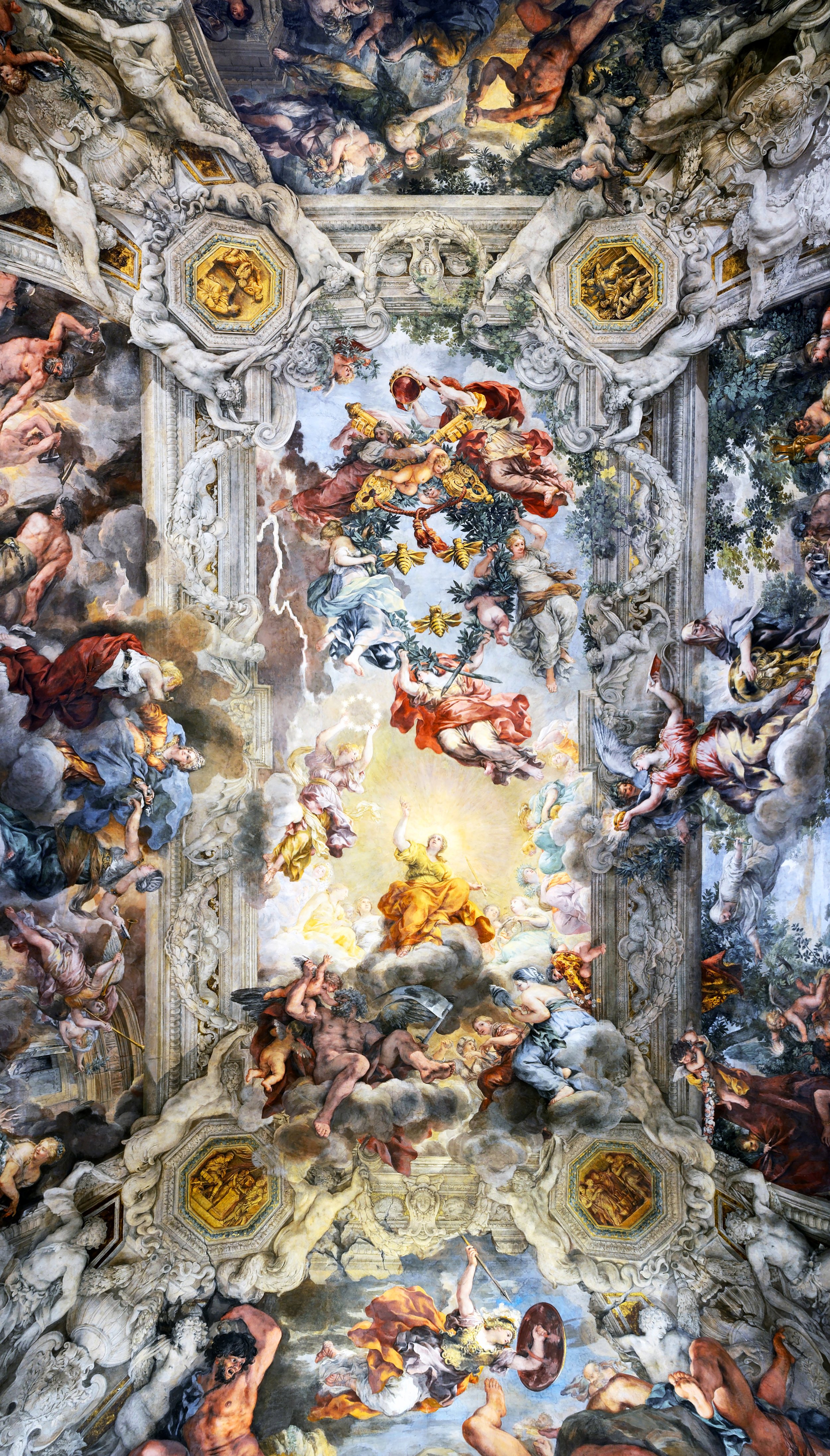
The Palazzo Barberini, at the base of Quirinal Hill, is the family’s greatest monument and now houses the Galeria Nazionale d’Arte Antica- one of the finest painting collections in Rome. The palace was designed by Carlo Maderna and was completed by Bernini after Maderno’s death in 1629. Borromini contributed the triple arched facade and an extraordinary oval staircase. Pietro de Cortona’s ceiling fresco in the Grand Salon is captivating and features the three bees of Barberini- the purest expression of self glorification in Rome. There are works by Raphael and Caravaggio. The palace is open daily and rarely as crowed as it deserves. The Gran Salone alone justifies a visit.
In terms of popular culture, the Galileo affair has sustained the most attention. Bertolt Brecht’s play “Life of Galileo” presents a Pope Urban who his an intellectual and moral coward- a petty individual who lost his nerve under pressure when he capitulated to the demands of the Inquisition. Dava Sobel’s “Galileo’s Daughter” covers the same events through the correspondence between Galileo and his convent dwelling daughter and is a very intimate and moving account. The Baldachin and the Bernini-Barberini relationship is central in Anthony Hughes “Bernini”. For the Palazzo and its ceiling, the Galleria Nazionale d’Arte Antica’s own catalog is excellent. The three bees remain one of the most recognisable symbols in Rome- once you start looking you will find them everywhere.