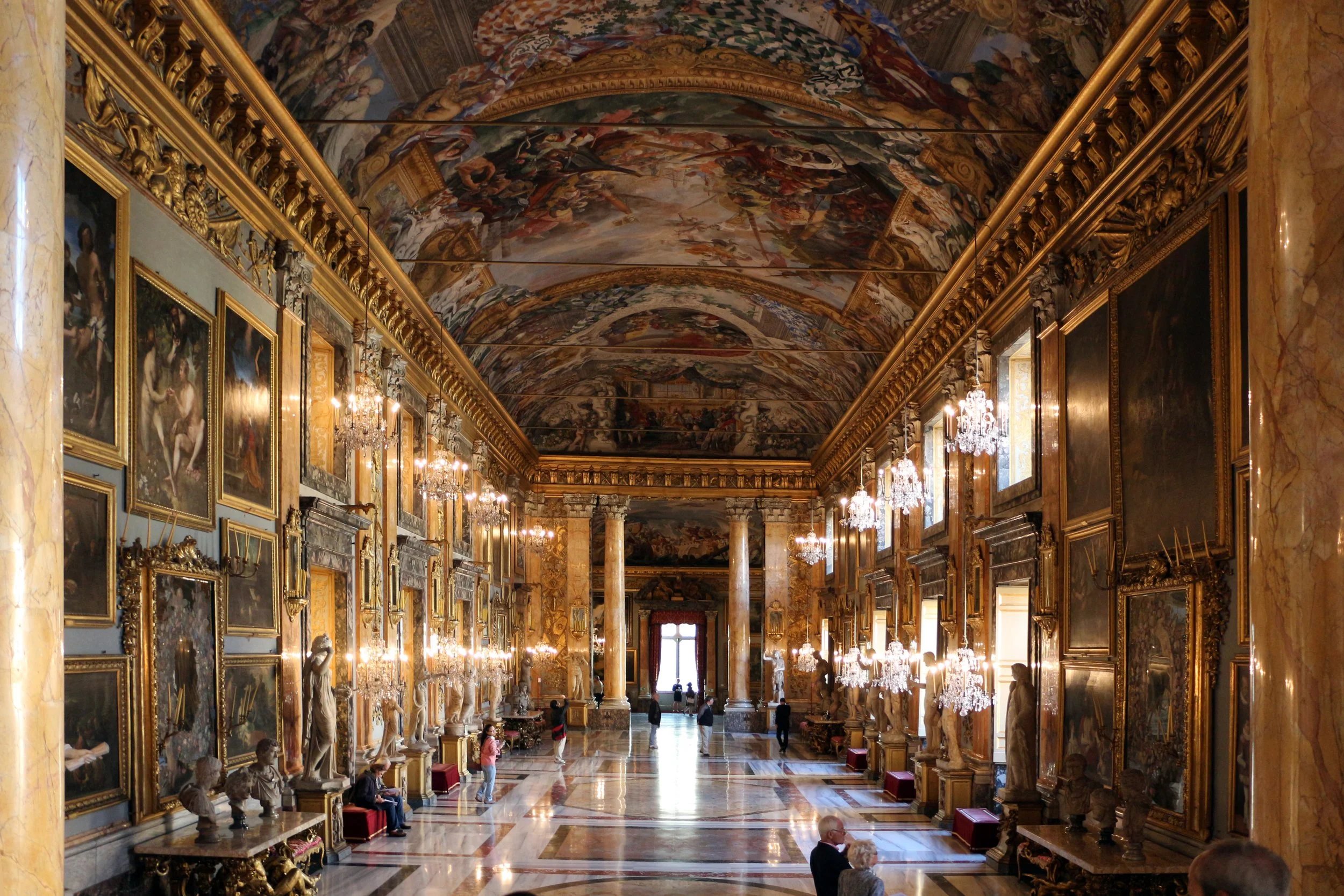
By I, Sailko, CC BY-SA 3.0, https://commons.wikimedia.org/w/index.php?curid=46231608
In the classic 1953 film Roman Holiday- an exquisite and very youthful European Princess played by Audrey Hepburn, conducts a final press conference after her state visit to Rome. Journalists played by Gregory Peck and Eddie Albert are in the audience. They had shared a rollicking, fun, romantic weekend with the Princess - an adventure not contemplated by the original agenda set by her courtiers. It is a sweet scene as they make eye contact with the Princess and confirm they will protect her privacy. You must watch the movie! BUT what does that have to do with a brilliantly crafted series on the great aristocratic families of Rome? Well, the scene was filled at Palazzo Colonna, Rome’s most spectacular private palace. Logic and curiosity lead us to investigate the Colonna’s. They are not as famous as the Borgias, Medici or Farnese but research confirms they are Rome’s oldest noble family. They are distinguished patrons of the arts and have maintained power and influence in Rome for centuries. Indeed, a fascinating tale. The family still resides in Palazzo Colonna and many tourists walk by totally unaware of the glories inside. There is an air of invisibility about the Colonna- under the radar despite their fascinating history. Let’s fill in the gaps.
The Colonna predate the Renaissance by several centuries. The first documented member, Pietro, lived in the late 11th century in a castle in the Alban Hills. By the 13th century, they were producing Cardinals and military commanders. There was an ongoing rivalry between the Emperor of the Holy Roman Empire and the Papacy. The Ghibilene versus the Guelph. The Colonna supported the Ghibilene and their main rival in Rome was the Orsini family who were pro Papacy and supported the Guelph. The single most dramatic episode in Colonna history occurred in 1303 when Sciara Colonna led King Phillip’s Army into the Papal residence at Anagni and seized Pope Boniface VIII. Sciarra slapped the Pope in the face, a shocking act that scandalised the medieval world. Local citizens eventually freed Boniface from captivity, but the humiliated Pope died a month later. Dante, who loathed Boniface placed him in hell in Dante’s Inferno. He placed Colonna in purgatory because the slap was a crime against the dignity of the Papacy- even if Boniface was a terrible Pope. The Papacy then relocated to Avignon and would remain in France the next seventy years. The Colonna were major players in this drama.
In the short term, the Colonna experienced some distress; lands confiscated, fortresses destroyed and family Cardinals stripped of their rank, but they were resilient and recovered their status quickly. The incident defined the family self image- powerful enough to humble a Pope and willing to use force when principle and family interests demanded it. This is a fundamental difference between the Colonna and every other family in the series. The Della Rovere, Farnese, Borgia and Medic all sought to control the Papacy, but the Colonna frequently fought it. The Colonna were local Romans with a long continuous history. The Medici and other prominent families were interlopers- newbies from other regions in Italy. The Colonna are classic old money.
The Colonna did realise a place in the Papal pantheon. The family’s supreme moment of ecclesiastical triumph came in 1417 when Cardinal Oddone Colonna was elected Pope Martin V at the Council of Constance. The Council was convened to end the Western Schism- the catastrophic forty year split with Church factions electing two and sometimes three competing Popes. Martin’s election ended a crisis that had threatened to destroy the institutional structure and moral authority of the Catholic Church. He returned the Papacy to Rome after nearly a century of Avignon exile. Pope Martin brought the Colonna to the height of their power. Martin enriched the family aggressively, awarding vast estates and titles throughout the Papal States. He simultaneously restored Rome’s physical infrastructure, much which had been damaged by neglect and factional violence. The Palazzo Colonna became the primary Papal residence for the duration of his Pontificate and the Throne Room today displays Martin’s portrait and his throne. Impressive!
The 16th century then produced two Colonna figures who decisively shaped the family cultural history and reputation. Vittoria Colonna was the most celebrated female poet of the Renaissance and was a muse to Michelangelo. She was widowed in 1525 and then dedicated her life to religious meditation and poetry. Her friendship with Michelangelo was special- he regularly gifted her drawings for her private collection. He was at her bedside when she passed away and lamented that he had never kissed her face- only her hand. Marcantonio Colonna then provided the military glory. He was Commander of the Papal fleet and defeated the Turks at the Battle of Lepanto. This ended the Turkish threat in the western Mediterranean and Phillip II rewarded Marcantonio by appointing him Viceroy of Sicily. The military prowess became a defining component of the family self image. They were warriors and artists. Finally, the family had a close relationship with Caravaggio. After his fatal duel in 1606, he found refuge with Costanza Colonna at Palazzo Colonna. She had been his patron and protector since the earliest days of his career and the family acquired several of his early works. The Colonna were always in the spotlight and they did not shy away from controversy. They were not dull!
The Palazzo Colonna is my favourite Roman Palazzo- more impressive than Farnese, Barberini, Borghese and Pamphli. The Great Hall is the centrepiece. It is 76 meters long and its vaulted ceiling is covered with frescoes depicting the Battle of Lepanto. Murano chandeliers hang in double rows before the windows. Marble tables are supported by carved Ottoman slaves- war trophies rendered in stone. The walls carry Tintoretto, Guercino and Bronzino works, hung from floor to ceiling. The Throne room features Pope Martin. The Palazzo is open Friday and Saturday mornings and you must book guided tours in advance. The tours are three hours and there is no better way to spend a morning in Rome.
The Colonna have a formidable legacy. They are not defined by one moment of supreme Papal power but by nine hundred years of continuous influence in Rome. They are unique. They have been Papal enemies and Papal allies. They have been military heroes, political opportunists, patrons of poets and artists and harborers of political fugitives. They slapped one Pope and eventually one rose to the office on their own. They have survived revolutions, Napoleon, Italian unification and two world wars. Many great Roman families burned brilliantly for a generation or two and then collapsed. The Colonna have outlasted all of them. The column on their Coat of Arms is an appropriate symbol. It is vertical, structural and load bearing- it is not deigned to dazzle but too last.
Colonna is underrepresented in popular culture. The Roman Holiday scene described above highlights the beauty of the Palazzo but doesn’t focus on the family. Vittoria Colonna’s relationship with Michelangelo is featured in Irving Stone’s The Agony and the Ecstasy. The Battle of Lepanto is celebrated in Chestrton’s poem “Lepanto.” For the long form family history I recommend the Palazzo Colonna website. It is written by a scholarly family descendant, is unusually candid and is essential reading before your visit.