The Orsini clan surpasses other famous families from the Roman elite by virtue of their incredible longevity. In American terms, they are analogous to descendants of the original settlers who arrived on the Mayflower. The Orsini’s documented history in Rome begins with Ursus de Paro in 998. The family legend is they are descendants of the Julio-Claudian emperors of ancient Rome. Whether that is true matters less than what it revels about the family’s self definition. They are Roman at their core and are entitled to a place of power by right of blood and history. The name Orsini derives from Orso- a bear- and a bear appears on every coat of arms, palace facade or family iconography. Their great rivals are the Colonna and these two titanic families spent three centuries trying to destroy one another. When taking a break from fighting against each other, they both built amazing fortunes. The Orsini are probably protesting right now that I discussed the Colonna in Part 5!
The Orsini were very consistent in their political alignments- they were loyal to the Guelph faction and the most vigorous pro Papacy defenders in the Roman aristocracy. This was not purely idealism or ideological- it was a pragmatic and hard nosed judgement on how to best guarantee the family’s influence and standing. Papal favour translated directly into territory, titles and church appointments. The Orsini were systematic in exploiting the relationship. They elected three Popes from the family and a total of 34 family members were appointed as Cardinals over three centuries.
The Orsini’s most consequential Pope was Nicholas III, elected in 1277. He moved the Papacy permanently back to Rome and initiated the construction of the Vatican Palace as the Papal residence. Setting the tone for all Popes who followed him he practiced nepotism with a breathtaking boldness. He appointed close relatives to every significant office and established Orsini territorial dominance in central Italy by claiming the best lands for the family. Dante despised him and placed Nicholas in “Hell “in the Inferno- stuffed headfirst into a hole in the ground with his legs kicking in the air, condemned for simony. It is one of Dante’s most vivid images and an eternal indictment of corruption at the highest levels of the Catholic Church. Pope Celestine III was another Orsini who proceeded Nicholas in the office. His focus was building landed wealth for the family in Rome and its environs. The third Orsini Pope is Benedict XIII who reigned form 1724 to 1730. He was a genuine reformer remembered for his personal holiness and a complete absence of administrative ability. His immediate court looted the Vatican treasury with impunity. The Orsini were also formidable military commanders for the Papal States. For almost five centuries, there was no more formidable family in Rome.
The Orsini engaged in high political intrigue throughout the Renaissance. In 1502, a group of Orsini Cardinals joined a conspiracy against Cesare Borgia who was systematically dismantling aristocratic privileges in his campaign to build a centralised Italian state. Cesare’s responded in a truly Machiavellian manner- he invited the conspirators to a reconciliation dinner on New Year’s Eve and had them all strangled. He imprisoned Cardinal Giambattista Orsini who then conveniently died while in custody. The Borgia rule collapsed later that year when Pope Alexander passed away, but it was too late for Cardinal Orsini. The Borgias dispatched, the Orsinis resumed their violent exchanges with the Colonna. Finally, Pope Julius II brokered a peace between the two rival families. Julius was savvy and understood that baronial warfare was incompatible with the stable and rich Papal state he was committed to building during his tenure, Pope Sixtus V upped the ante and arranged a marriage between the Colonna and Orsini. After four hundred years of assassinations, incessant plotting and vendettas, the “Bear” and the “Column” were united under the same family tree. Fun facts!!
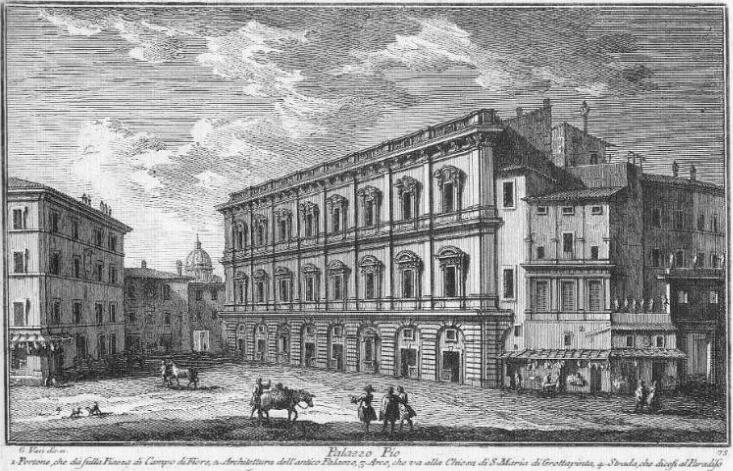
The Orsini left an interesting and rather unique architectural and design legacy. In Rome, the family’s surviving monument is the Palazzo Orsini on the Campo de Fiori, built over the ruins of the Theatre of Pompey. Unfortunately, the building is not publicly accessible. The Castello Orsini-Odelsachi at Lake Bracciano, thirty kilometers north of Rome is a striking fortress- a 15th century castle of considerable grandeur that is open to the public. However, the essential Orsini experience is Bomarzo, an hour’s drive north of Rome. It is open daily and I recommend you go early morning and allocate a half day for your visit. It is a very strange place- a garden of enormous stone monsters carved from volcanic rock. There is a giant’s mouth large enough to walk into with the inscription reading “All reason departs.” There are elephants crushing Roman soldiers, dragons fighting lions and a tilted house that makes you lose your balance. This “Park of Monsters” was commissioned in 1552 by Vicino Orsini. He had been a successful military commander for the Papal Army and became despondent when he returned home after years of battle and found his wife, Giulia Farnese (a descendant of Borgia’s mistress of the same name) dead. He decided to build a monument to his late wife. Bomarzo Garden is the result and represents grief, chaos and the grotesque. It is the opposite of sublime Renaissance gardens like Villa d’Este and Villa Lanta which are orderly, symmetrical rational and beautiful. The Orsinis followed their own path- ALWAYS!
The Orsini have attracted less popular culture attention than some of their rivals. The Orsini conspiracy against the Borgias appears in both Sarah Durant’s Blood and Beauty and the Showtime Borgia series. Anthony Majaniahti’s The Families Who Made Rome is both scholarly and user friendly and he dedicates a chapter to the Orsini. The Bomarzo saga involving Vicino Orsini and his depression became an Argentinian opera written by Alberto Ginastera in 1967 and is one of the most celebrated Latin American operas of the 20th century. It was banned by the military dictatorship in Argentina for years because of sexuality and violence. How Orsini- How Roman!!