Jeremy Irons magnificent portrait of Pope Alexander VI in the Showtime series The Borgias established the Borgia family image for a new generation of Renaissance aficionados. They were portrayed as outrageously corrupt, sexually voracious, politically ruthless and entirely without shame. The series is excellent entertainment and captures the atmosphere of Borgia era Rome with vivacity and intelligence. However, the historical accuracy of the program is subject to debate. Were the Borgias unique in their notoriously monstrous behaviour or is the program just a vehicle for spreading a poisonous mythology? Or were they just better at mastering the nuances of Renaissance Papal politics than their contemporaries? They were certainly charming and cunning. Was their fatal mistake just being of Spanish origin in a Rome that has always been resistant to foreigners having power? Let’s take a closer look at the record.
The Borgias-Borja in their native Spain- were a minor noble family from Valencia in the Crown of Aragon. Their transition to Italy and Rome began with Alfonso de Borja, a canon lawyer of genuine ability who rose through the Church on merit and was elected Pope Calixtus III in 1455- a compromise candidate whom the Cardinals believed would not live long. He lasted only three years and made only two decisions of historical importance. He ordered the posthumous retrial of Joan of Arc and she was found innocent and later canonised. Second, he made his nephew Rodrigo a Cardinal at the age of 25 and Rodrigo would go on to shape the next 50 years of European history.
Rodrigo was a whirlwind of activity and ambition. He spent 36 years as a Cardinal and accumulated enormous wealth and power. He became Vice Chancellor of the Church responsible for running day to day operations at the Vatican. On the personal front, he had a long term mistress named Vanozza del Cattanei with whom he had four children that he openly acknowledged. He then, at the age of 58, developed an intense relationship with a new mistress- the 15 year old Giulia Farnese, the female scion of one the most important families in Rome. He definitely possessed a high energy level. Despite his rather complicated web of romantic and family relationships, he convinced the College of Cardinals to elect him Pope in 1492. He defeated Giuliano Della Rovere (later Pope Julius II) and his successful candidacy was expedited by the most brazen acts of bribery and simony in conclave history. Rodrigo, to put it bluntly, purchased the Papacy. He took the name Alexander VI.
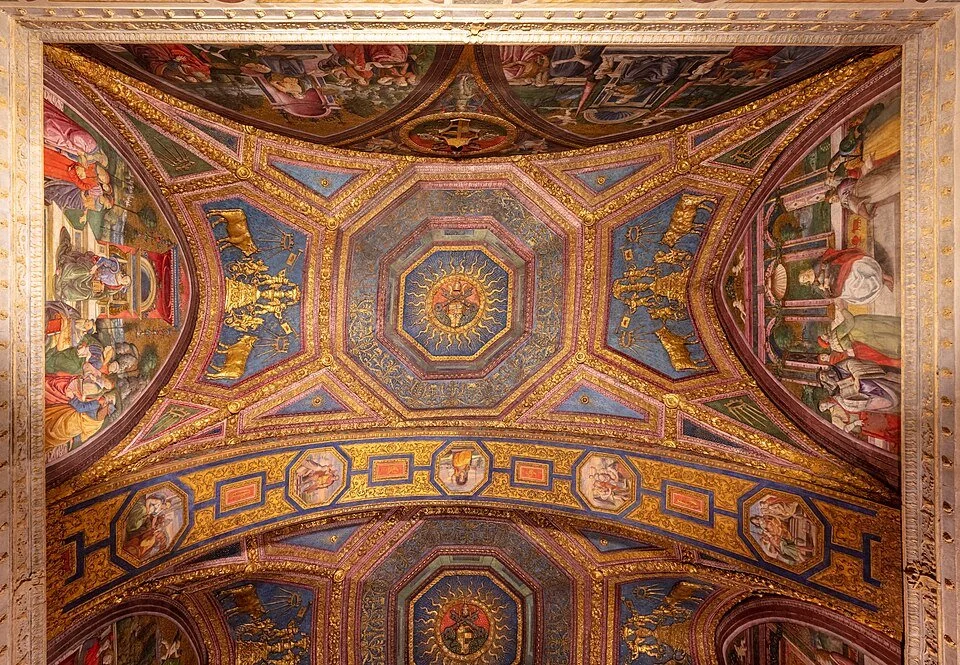
Pope Alexander VI was an extraordinary figure in many ways. He was physically imposing, politically shrewd, charming, witty and possessed strong administrative skills. His years of experience in Rome meant that he knew where all the bodies were buried! He commissioned the master artist Pintiricchio to decorate the Borgia apartments in the Vatican and you can visit them today. They are stunning. The Pope actually insisted the artist use the Pope’s daughter Lucrezia as the model for Saint Catherine of Alexandria in the paintings. Pope Alexander truly mastered the “The Art of the Deal,” using the Catholic Church as a profit generating family business with a frankness that even this freewheeling era found breathtaking. He made his son Cesare Archbishop of Valencia, arranged politically strategic marriages for Lucrezia with the efficiency of a skilled lawyer and funneled huge Church revenues into Borgia dynastic ambitions without apparent guilt. You read this stuff and you wonder why The Reformation didn’t begin a century earlier!
He made his mistress Giulia’s brother Alessandro a Cardinal and Alessandro was saddled with the nickname “the petticoat Cardinal.” The same Alessandro would eventually become Pope Paul III and commission Michelangelo’s Last Judgement. Rome certainly rewards patience and family loyalty. Pope Alexander’s tenure was subject to endless rumours of immoral and indecent behaviour within the walls of the Vatican. The darker allegations include systematic poisonings of political rivals, sexual orgies and bacchanalian feasts. There is significant dispute among historians on the accuracy of these charges. The primary source is Johan Burchard, the Vatican Master of Ceremonies, who kept a diary that recorded these events with precision and flair. What is beyond dispute is that enemies of the Borgias had a way of dying suddenly. The defenders of the Borgias argue that the family’s Spanish identity made them lighting rods for every grievance the Italian establishment harboured against a Pope they believed had stolen the Office. I prefer to believe all the wild stories- makes the Borgias more fun and Renaissance history more entertaining. If even half are true, the Borgias are a poster child for scandalous behaviour.
Cesare is worthy of his own blog entry! He was formidable. Originally forced to become a Cardinal by his father the Pope, he resigned in 1498 after his brother Giovanni’s murder on a bridge over the Tiber River. There is strong evidence that Cesare ordered the murder of his brother because he wanted to get back into the center of the action in Rome and Giovanni’s departure from the scene made that easier. Cesare immediately embarked on wildly successful military career. Acting with remarkable speed and brutality, he conquered the Duchies of Romagna, Umbria and Emilia within three years. He basically created the Papal States through military force and targeted assassinations. Among his instruments was Leonardo da Vinci whom he hired in 1502 as his “Architect et Ingenero Generale” issuing him an unlimited pass to inspect and direct all construction in Cesare’s domain. Machiavelli was also in Cesare’s court. At one point in 1502, three of the most extraordinary figures of the Renaissance were operating in the same orbit. Cesare also established The Castel Sant Angelo as a family fortress and refuge and fortified the Passeto di Borgo corridor as a safe passage between the Vatican and the castle. The Borgias used it on several occasions when the natives in Rome became restless.
Niccolo Machiavelli watched Cesare operate and came away with a complicated admiration. In “The Prince” Cesare becomes the archetype of the new ruler- unbound by conventional morality, decisive and willing to whatever is necessary to maintain power. Unfortunately for Cesare, his good run came to an abrupt end when Alexander VI died suddenly in 1503. Julius II, Alexander’s successor and the Della Rovere who had spent ten years in exile seething over Borgia domination dismantled everything Cesare had built. With his entire power edifice gone, Cesare died at 31 in a minor skirmish in Navarre. Power and fame was fleeting for him.
Lucreza Borgia is also a fascinating tale. She has been defamed posthumously with charges of incest and sexual excess. The incest allegations originated with her first husband Giovani Sforza who vindictively spread the rumour after Pope Alexander annulled their marriage when the Borgia alliance with the Sforzas of Milan was no longer useful to the Pope. Her femme fatale and temptress image is a 19th century literary creation- specifically Victor Hugo’s 1833 play. The actual Lucrezia was a woman of considerable intelligence with very little control of her own life. She was married three times before 22, each marriage arranged for political purposes. After her father’s death, she settled in Ferrara as a Duchess, married happily to Alfonso D’Este. She governed the Duchy capably when her husband was away on military duty, patronised poets and artists and is remembered by the citizens of Ferrara as “La buona duchess, the good Duchess.” She died at 39 and was mourned genuinely. Good for her!!
The Borgias left a thinner artistic legacy than the Della Rovere contemporaries. They did commission Pinturicchio to beautify the Borgia Apartments in the Vatican Museum and the frescoes are outstanding. Most visitors rush past them on the way to the Sistine Chapel- DON’T! The Della Rovere’s did the Sistine Ceiling and commenced the rebuilding of St Peter’s. However, I am struck by the similarities between the families, not their differences. Both famously bought Papal elections and both practiced a corrupt nepotism without restraint. Both fathered children they were not supposed to have. The Della Rovere’s are honoured with a legacy of artistic ambition and excellence. The Borgias are the ultimate emblem of power without conscience. History can be unfair. We should all remember the victors write the histories and the Della Rovere family was the victor and the Borgias the vanquished in their century old Renaissance rivalry.
In popular culture, The Borgias Showtime series is the loadstar. For historical fiction, Sarah Dunant’s Blood and Beauty and its sequel In the Name of the Family are the most rigorously researched treatments and Lucretzia is handled with nuance. Mario Puzo (author of The Godfather) also tackled the Borgia drama in The Family which was published posthumously. It is very readable- a compulsive beach read. Paul Strathern’s The Borgias: Power and Fortune is the best single popular history. G.J. Meyer’s The Borgias: The Hidden History is the essential scholarly work that challenges some of the mythology surrounding the family’s image in pop culture.