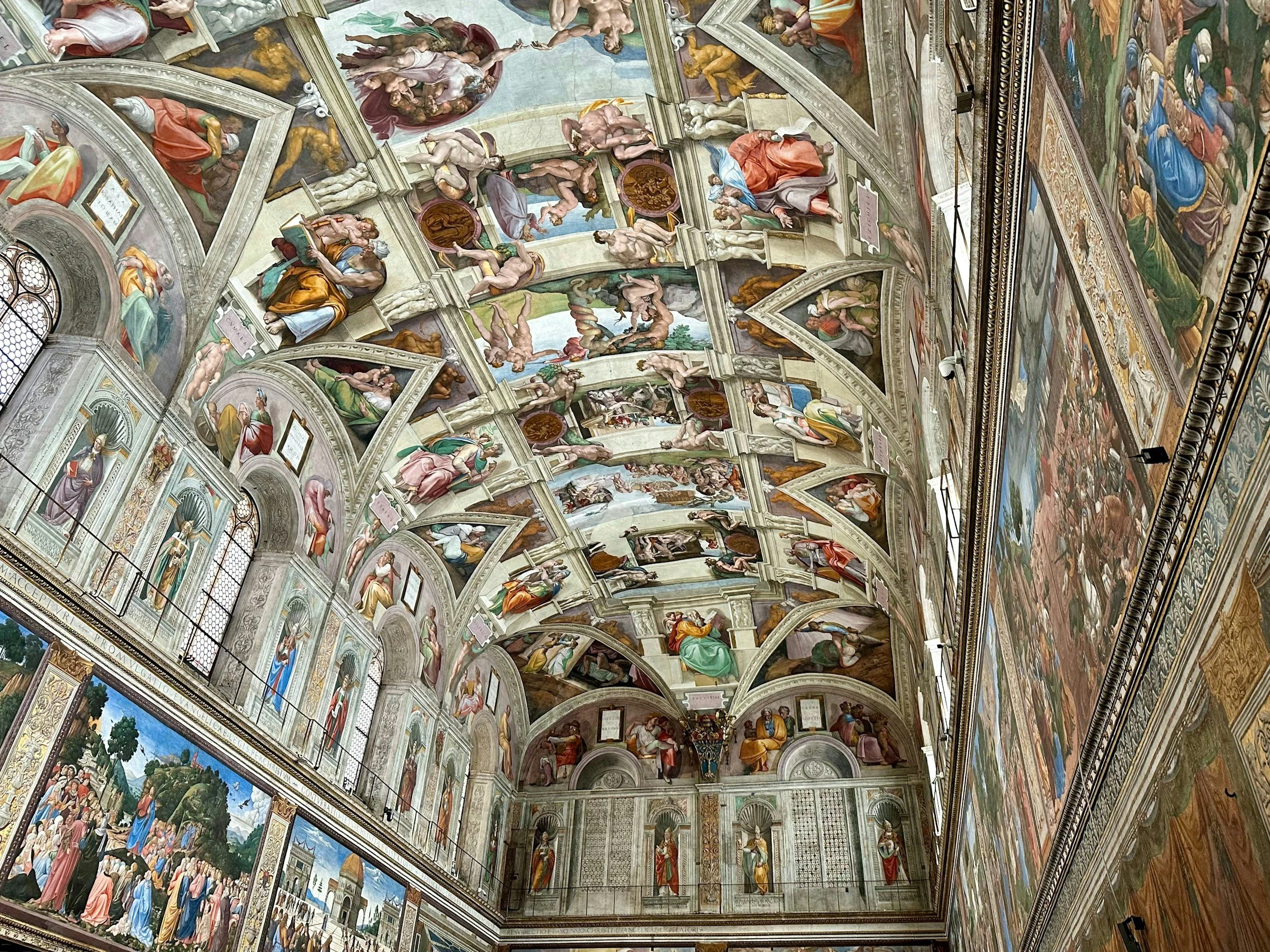
If you have seen the Hollywood epic The Agony and the Ecstasy, you have already absorbed a compelling portrait of the Della Rovere’s family greatest figure- Pope Julius II. Rex Harrison is outstanding as the imperious and impatient Pope who commandeered Michelangelo to adorn the Sistine Chapel with one of the greatest works of art in human history. There is more to the Della Rovere’s story than Pope Julius. It is a rag to riches Renaissance narrative. The family impact on the Rome you visit today is undeniable.
The Della Rovere’s came from Savona in Liguria- a coastal backwater of no particular distinction. Their origins were humble- no land, no titles and none of the inherited prestige of Rome’s ancient baronial families. What they had was one brilliant and ambitious man- Francesco della Rovere. He was born in 1414, entered the Franciscan order as a boy and rose through sheer intellectual force to become the order’s Minister General by 1464. He continue this climb up the church hierarchy and was elected Pope Sixtus IV in 1471. Who said Rome wasn’t a meritocracy? His ascendance to the Papacy instantaneously and totally transformed the status of the Della Rovere clan.
Pope Sixtus did not waste a moment in integrating the family into the corridors of power. Within months of his election, he made six nephews Cardinals, arranged advantageous marriages for those who were laymen and systematically acquired territory that would anchor the family’s secular power for the next 150 years. His most consequential strategic move was engineering the marriage of his favourite nephew to the daughter of the Duke of Urbino. This was long range dynastic chess and the Della Rovere inherited the Duchy when the Montefeltro family line died out. Pope Sixtus transitioned the family from Ligurian obscurity to Dukes of Urbino in two generations. Truly impressive!
Pope Sixtus created a complicated legacy. He was a builder, a schemer and an arts patron. He was magnificent and rather shameless. He restored over 30 churches, including Santa Maria del Populo, rebuilt the Ponte Sisto, reorganised the Vatican Library and named and decorated the Sistine Chapel. He recruited Botticelli, Perugino, Ghirlandaio and Signorelli to paint the Vatican walls. Against this amazing backdrop, he a was complicit in the Pazzi Conspiracy- a nefarious assassination plot against the Medicis in Florence orchestrated by his nephew Girolamo. The Medici bank had refused to finance a papal land purchase and Sixtus gave the plot a carefully worded blessing. On Easter Sunday during High Mass at the Florence Cathedral, Giuiiano de Medici died on the altar after being stabbed 19 times. Lorenzo Medici was wounded in the attack, but escaped with his life. Pope Sixtus, with incredible chutzpah, then excommunicated Lorenzo for hanging the conspirators. The affair ended in an uneasy peace with Lorenzo dispatching Botticelli and other Florentine artists to Rome as diplomatic gesture. The excommunication was lifted and Sixtus got his gorgeous Sistine walls. The Art of the Deal!
Pope Julius II then expands the Della Rovere legacy. Named Giuliano, he was another Sixtus nephew who spent 30 years as a Cardinal before being elected Pope Julius in 1503. It was the shortest concave in papal history because Julius strategically bribed the key movers and shakers in the College of Cardinals. He then embarked on a remarkable 10 year term. He brought the Renaissance to full bloom. He is another complicated fellow- a warrior, quasi tyrant and a lover of the arts and artists. Julius commissioned Michelangelo to paint the Sistine Ceiling in 1508 and he browbeat the master artist for four years until the project was completed in 1512. He simultaneously conscripted Raphael to work on the Vatican Stanze, commissioned Bramante to begin rebuilding St Peter’s, established the Vatican Museums and commissioned Michelangelo to build the Moses tomb- the greatest Papal tomb ever- for you guessed it JULIUS! The tomb took 40 years and Julius died thirty years before its completion. Ces’t la vie! Julius did all this while personally leading armies all over Italy clad in full armour, liberally excommunicated his political enemies and conducted a ruthless vendetta against the Borgias- the family that preceded him in the Papacy. Erasmus, the great philosopher noted that Pope Julius seemed to be completely unaware of spiritual component the office he held.
The Duchy of Urbino was the final chapter for Della Rovere greatness. The Court of Urbino was a highly respected fiefdom that became magnificent under Della Rovere rule. It was the family’s Urbino connection that brought Raphael to Rome. Raphael’s father was the court painter in Urbino and Julius “discovered” the genius of Raphael on a family visit. Successive Della Rovere Dukes sustained the patronage tradition; Guidobaldo commissioned Titian’s Venus of Urbino. The male line ended in 1631. The last Della Rovere heiress married into the Medicis and the family art collection can be seen in the Uffizi Galleries today. Closing the circle by unifying two of the most powerful Italian families of the Renaissance.
In popular culture, we have already referenced Rex Harrison as Julius II in Agony and the Ecstasy. Irving Stone’s novel of the same name is an engaging work of historical fiction. The Pazzi Conspiracy is a fun episode in The Medicis- an engaging Netflix mini series. It is also featured in the Assasin’s Creed video game franchise. For scholarship, Christine Shaw’s Julius II: The Warrior Pope is the authoritative biography and Ross King’s Michelangelo and the Pope’s Ceiling is the most vivid account of the Sistine Commission. Enjoy!