“The Loneliness of Sonia and Sunny” by Kiran Desai
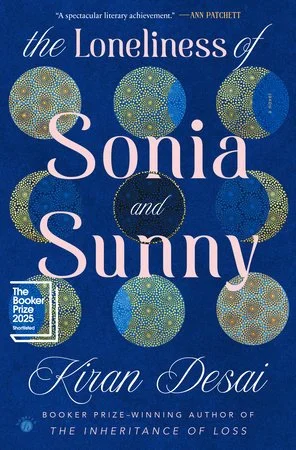
I discovered Kiran Desai’s The Loneliness of Sonia and Sunny when it appeared on the 2025 Best Books lists published by The New York Times and The Economist. I have come to trust these two sources for their high standards and discerning judgment and when a book is honoured on both lists, I pay attention and add the book to my reading plan for the upcoming year. Desai’s novel was my first poolside read of 2026. Thank you Miami Beach.
Desai arrived on the international literary scene with considerable fanfare when she won the 2006 Man Booker Prize for The Inheritance of Loss, becoming at 25 the youngest woman ever to receive that award. The novel also won the National Book Critics Circle Fiction Award and earned widespread critical acclaim for its exploration of colonialism’s legacy, globalisation and the immigrant experience. The Guardian called it “a magnificent novel of humane breadth and wisdom”, while The Washington Post praised “its extraordinary ability to bridge cultures and capture the texture of two worlds at once.” These accolades established Desai as a serious literary figure working at the highest level of contemporary fiction.
I read The Inheritance of Loss fifteen years ago and found myself admiring the work more than loving it. The novel was unquestionably ambitious and beautifully written, but I struggled with some of the characters and the narrative was tough going. Still, Desai’s talent was undeniable and I remained curious about where her writing career would go next. Now, two decades later, The Loneliness of Sonia and Sunny is her long awaited second act.
Desai’s work joins a distinguished tradition of Indian and Indian American writers exploring the complexities of their culture and the immigrant experience. I have long been drawn to this literature- Salman Rushdie’s Midnight’s Children, Arundhati Roy’s The God of Small Things and Jhumpa Lahiri’s The Namesake and Interpreter of Maladies were great books- beautiful and provocative. What attracted me to these works is their rendering of a culture of extraordinary richness. The Indians in these books have an intricate and multilayered family dynamic, a deep reverence for art and learning and a powerful drive for educational achievement and economic success. In many respects, they are the most successful emigres in the United States and the United Kingdom. These novels captured the beauty and tension inherent in Indian life- the battle between old world family obligations and modernity and the inevitable challenges that come when straddling two worlds. The Loneliness of Sonia and Sunny embraces this established tradition and tackles many of the same themes that Rushdie, Roy and Lahiri explored with such distinction.
My reaction to this new novel echoes my response to her debut: impressed, exhausted and ultimately ambivalent. The scope of the novel is staggering. Desai takes us from Vermont to New York, from Kansas to Mexico, then across to Italy before plunging us into India, Allahabad, Goa and New Delhi. The geographic sprawl mirrors the thematic ambitions of the book. We engage with romance across cultures, sexual awakening, parent-child relationship issues, the challenges of Indian emigres in America, the role of art in life and the impact of entrenched sexism and racism. We get a large dose of Indian cultural insecurity vis a vis the United States, witness endless forms of abuse and always return to the many forms of loneliness. The writing is frequently gorgeous, flashing moments of genuine insight and beauty.
Unfortunately, the novel’s virtues are shadowed by significant weaknesses, the most obvious being its length. At over 500 pages, the book is exhausting and uneven and is weighed down by too many characters- some of whom are distracting from the main narrative. Sunny’s extended family of small time local crooks add little to the big picture narrative. More problematic is the uneven treatment of the two main protagonist, Sonia and Sunny. Sonia emerges as the far more interesting character. Desai goes deep on her thought process and her vulnerabilities are laid bare. Her weaknesses and questionable choices are examined in depth. Her relationship with a predatory American artist is deeply disturbing- he manipulates and exploits her in ways that are painful to witness. Paradoxically, this dysfunctional relationship produces some of the novel’s most compelling pages. The artist himself, despite his moral bankruptcy, stands as the book’s most fascinating character. He is brilliant, psychologically complex and a professional liar. Sonia is out of her depth with him and spends the balance of the novel attempting to recover her identity, confidence and purpose.
Sunny never achieves the same depth. His relationship with his American girlfriend Ella is dull and lacks the intensity and danger which animated Sonia’s character. His angst, while no doubt genuine is tiresome. He seems largely responsible for creating his own problems and his self absorption generates crises that seem avoidable. He simply doesn’t command the reader’s attention the way Sonia does. His mother, a major character in the book page wise is more irritating than illuminating. Sonia’s family offers far richer material. She has a mysterious German grandfather and an independent mother who makes the bold choice to leave her husband and live in the countryside. Sonia’s support network is far more multilayered than Sunny’s. This unevenness extends to a more fundamental problem- the characters don’t rock my world. Yes, they are caught between countries and cultures and struggling with their identity. BUT, these are not hardship cases. They are privileged people with economic, educational, professional and social advantages. Frankly, I found it difficult to fully invest in their dilemmas. They were very modern characters- self absorbed and narcissistic whiners.
Desai makes gestures to the deeper nuances of Indian culture. We are exposed to the spirituality and magic realism that infuses daily life. We also encounter the shocking societal inequality and the persistent Hindu-Muslim divide. However, these themes are underdeveloped, touched upon rather than explored deeply. This may be inevitable given the novel’s already enormous scope, but it contributed to my sense that Desai was only skimming across the surfaces of a vast and intricate culture. I was also frustrated - shaking my head regularly, at the choices made by Sonia and Sunny. At times, their crises are totally self manufactured. They also make the same type of mistakes again and again. They may be gifted, but their emotional IQ is low and their self regard blinded them to the consequences of their decisions. I stuck with the novel to the end- a rather predictable ending by the way, but the novel never captured my heart. The technical skill and deft prose carries you through long stretches of the book, but the ultimate emotional reward is missing.
The Loneliness of Sonia and Sunny is a flawed work, overly dense and unevenly paced. I conclude the critical acclaim was overdone. However, there is value in Desai’s ambition and her refusal to simplify or compromise her message. You learn a great deal about a world far different than your own, although ultimately I emerged more admiring than moved, more impressed than enchanted. For readers willing to commit to its considerable length, the novel offers rewards- just not quite to the extent I hoped for when I began.