Spotlight on Books: WFM’S All Time Best: “The World of Yesterday” by Stefan Zweig
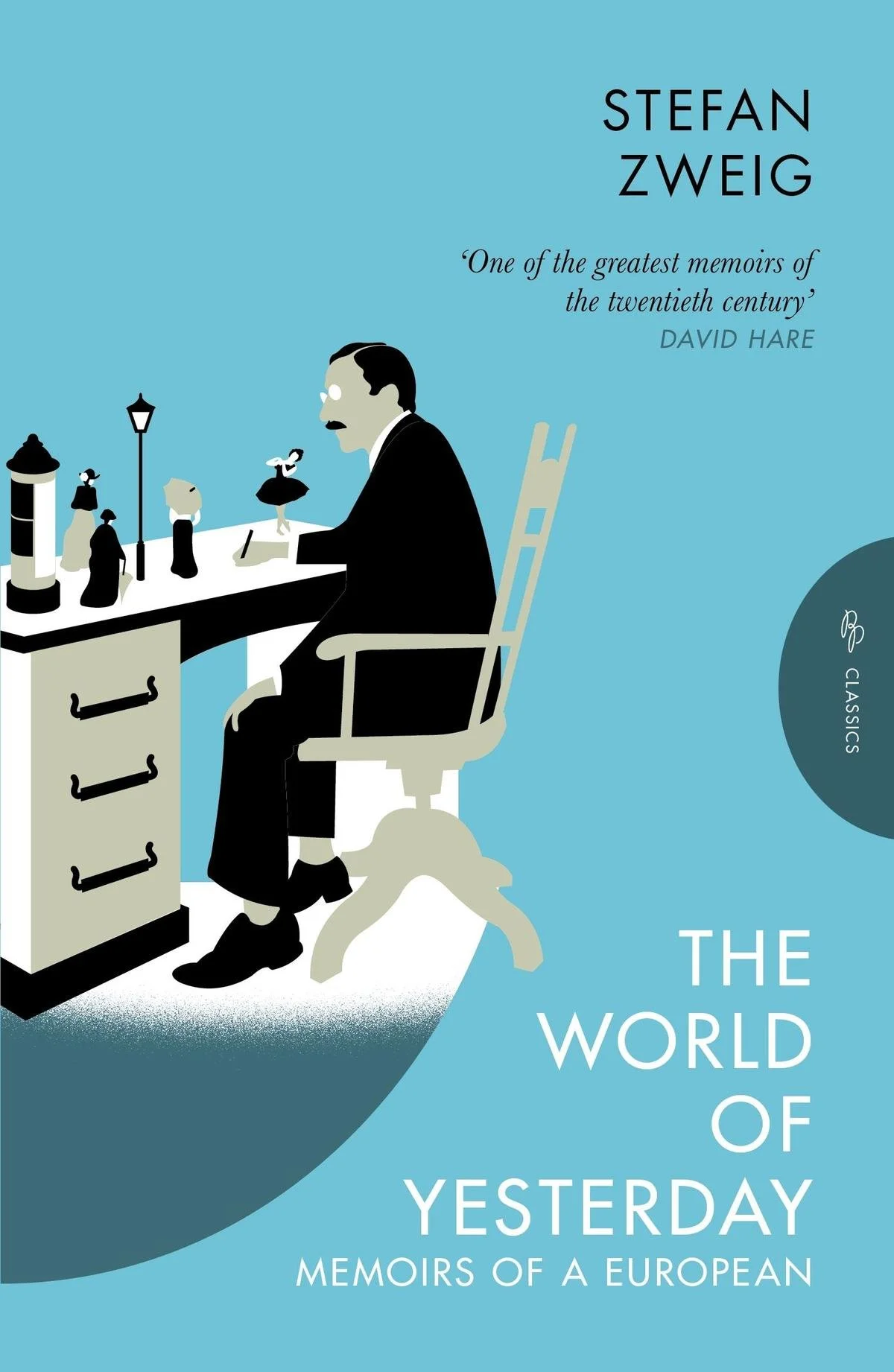
This is a must read for our challenging times. It was written as a memoir in the early 1940’s, but its insights are incredibly relevant today. First, for the uninitiated, who was Stefan Zweig? He was for a time, the most widely translated author in the world- a remarkable distinction that the passage of decades has done little to diminish. He was a genuine global author in the 1920’s and 1930’s. He was born in 1881 to a prosperous Jewish bourgeois family and came of age in the twilight years of the Austro- Hungarian Empire. The Hapsburgs had ruled a vast, multiethnic empire for over 1000 years. To the citizens of Vienna, it seemed to be a permanent fixture on the European continent. It stretched from the Alps to the Carpathian. Zweig was intimately familiar with its culture and rhythms and is a powerful commentator on the reasons for its demise in WWI.
Zweig was a prodigy of restless intellectual energy. He studied philosophy and literature in Vienna and Berlin, traveled incessantly, and by his 20’s had established himself as a poet, playwright, biographer and short story writer of the first rank. His novellas displayed an uncanny psychological precision and a gift for inhabiting the inner lives of his characters. His biographical studies- of Erasmus, Mary Queen of Scots, Magellan, Marie Antoinette and Balzac, brought historical figures to vivid life and sold in enormous numbers across Europe and the Americas. He was heavy bulb- a big deal- an internationalist and a globalist- a polished European version of Mark Twain. It is sad that students are not more regularly exposed to his writings today.
What truly set Zweig apart was his astonishing network of friendships and correspondence. His address book was a roster of European’s civilisation’s finest minds. A super rolodex that included Sigmund Freud, Theodore Herzl, James Joyce, HG Wells, George Bernard Shaw, Auguste Rodin, Maria Rilke, Romain Rolland, Benedetto Croce, Richard Strauss and Salvador Dali. He was, in the truest sense, the first citizen of a cosmopolitan European Republic of letters- a tireless advocate for cross cultural understanding and what we can now recognise as an embryonic ideal of a unified Europe. Unfortunately, Zweig’s eminence and character made him everything the Nazis despised: Jewish, intellectual, an elitist and most damningly - a man who rejected racism and nationalism. When Hitler came to power, Zweig’s books were the first to be burned. He fled Austria in 1934, eventually making his way to London, then New York and finally Brazil. In 1942, with Hitler at the peak of his powers and the Final Solution underway, Zweig and his wife, seeing no light at he end of the tunnel, committed suicide. He was 60 years old. This memoir was completed the day before his suicide. It is his last will and testament -a farewell to civilisation. The World of Yesterday was published posthumously.
The memoir is an elegy to a lost world. It is unusual because Zweig made the intentional decision not to discuss his two marriages, his family, his romances or the texture of his domestic life. His childhood and education are only touched upon in the introductory chapters. What he offers instead is something more rare and ultra ambitious- a cultural memoir, a sustained act of historical witness. His writing is a passionate and powerful effort to preserve the memories of a better world that had been obliterated. It is a book about values - a plea for a better world and a rejection of the brutality inherent in Nazism, Fascism and Communism.
The world he describes- Vienna at the turn of the century- shimmers with an almost unbearable beauty. It is a city devoted to the arts. Music, literature and theatre were not just entertainment- they were civic religions that defined a culture. The opera was the moral center of public life. Intellectuals were celebrated and artists were venerated. Beyond Vienna, Europe seemed to have arrived at a permanent place of peace, progress and civilisation. There had been no conflicts among the Great Powers since the 1870 Franco-Prussian War. Trade was incredibly free and booming economies had produced stunning architecture in the major capitals. Borders were generally open and Zweig recalls traveling across the continent without a passport. Internationalism was not a slogan, but was the lived reality for cultivated Europeans, particularly the elite. Jews prospered in Berlin, Vienna and London and served as bankers for the German, Austro- Hungarian and Russian empires. Zweig renders this vanished world with precise and beautiful prose. He is a master of language. He knows he is writing an eulogy- a portrayal of what was lost. Then, as a master storyteller with an eye for detail and and an acute moral compass, he shows us how it was all destroyed.
The memoir shows how civilisations descend into the abyss and eventually collapse. The most gripping sections of the book describe not the catastrophes themselves, but the processes by which catastrophe becomes possible and then inevitable. Zweig is brilliant on what I would label the “gradualism of barbarism”- the way in which standards erode incrementally with each outrage normalising the next one until you finally reach the point where the unthinkable has become routine. People give up and the forces of disorder and evil prevail. It isn’t sudden, but it is systematic.
Zweig watched the First World War erupt with the enthusiasm of crowds and he charts with horrifying clarity how intelligent and decent people convinced themselves to support a cause which Zweig immediately identified as mass insanity. The body counts were enormous on both fronts and the peace that followed the carnage was no peace at all. Versailles created weak and resentful nation states that were gradually destroyed by reparations and an inflationary spiral that destroyed the savings and dignity of the middle classes in Germany and Austria. The people who were the backbone of the old culture of stability and reason gradually became radicalised or at minimum docile. Then he portrays the failures of democracy- the inability of liberal institutions to defend themselves against nihilistic and brutal movements. Zweig details how freedom of expression was suppressed, how political violence became normalised and how anti semitism and prejudice evolved into pogroms, concentration camps and mass death. His descriptions of the Nazi era are chilling in their specificity: the casual cruelty, the bureaucratic machinery designed to humiliate and dehumanise and the open contempt for human dignity. He understood that what he was witnessing was not a short term political aberration but a civiilsational rupture. And millions died! Zweig vigorously describes the loss of innocence - how people lost faith in the future and realised that progress was not inevitable or guaranteed. Barbarism, once released, has its own momentum. Civilisations can go backward!
Zweig’s themes resonate today. Reading The World of Yesterday now, in our own moment of democratic backsliding and resurgent nationalism, one is struck repeatedly of how history may be repeating itself. It is DISTURBING! Zweig’s observations about the mechanics of authoritarianism feel less like history and more like a diagnostic manual. The patterns he identifies- economic anxiety exploited by demagogues, demonisation of the “other”, the gradual normalisation of previously unacceptable rhetoric, the abandonment of international legal norms- are not difficult to recognise today. The book’s emotional register is quietly extraordinary. Zweig rarely rages and almost never despairs explicitly. He is man of immense cultivation who maintains an erudite tone as he describes the end of everything he loved. The anguish is all the more powerful because it is understated. The anger underlying the measured prose is felt by the reading audience because he has chosen not to shout. Shouters (and we know who they are) should not be trusted! He does project an uncontrolled grief by the end of the memoir. When we learn he committed suicide immediately after finishing the manuscript, the effect is shattering.
The World of Yesterday is a magnificent piece of writing. As a portrait of culture and history, it is without peer. As a document of witness, it rivals Primo Levi. It is powerful cautionary tale of how things we take for granted- peace, openness, the free exchange of ideas, the assumption of progress- can be lost quickly. He forces the reader to self evaluate! Are we paying sufficient attention to what may be at risk today. Are we experiencing a societal erosion that reflects what he observed in his own time. Sadly, Zweig, died before the Allied victory in WWII. He never witnessed the reconstruction of Europe, the long post war peace and the development of an actual European Union- one of his life goals. In some sense, the world he fought for did arrive- imperfect and incomplete, but recognisable. Now, and it is eerie, this European world faces its own pressures, its own demagogues, a retreating tide of internationalism and a loss of liberal confidence. Scary!
Read this book. Read it as a great memoir and a literary achievement of the first order. Read it as history- intimate and painful. And read it as a warning offered by a great man who watched his own civilisation collapse. He tells us all exactly how it can happen- AGAIN!