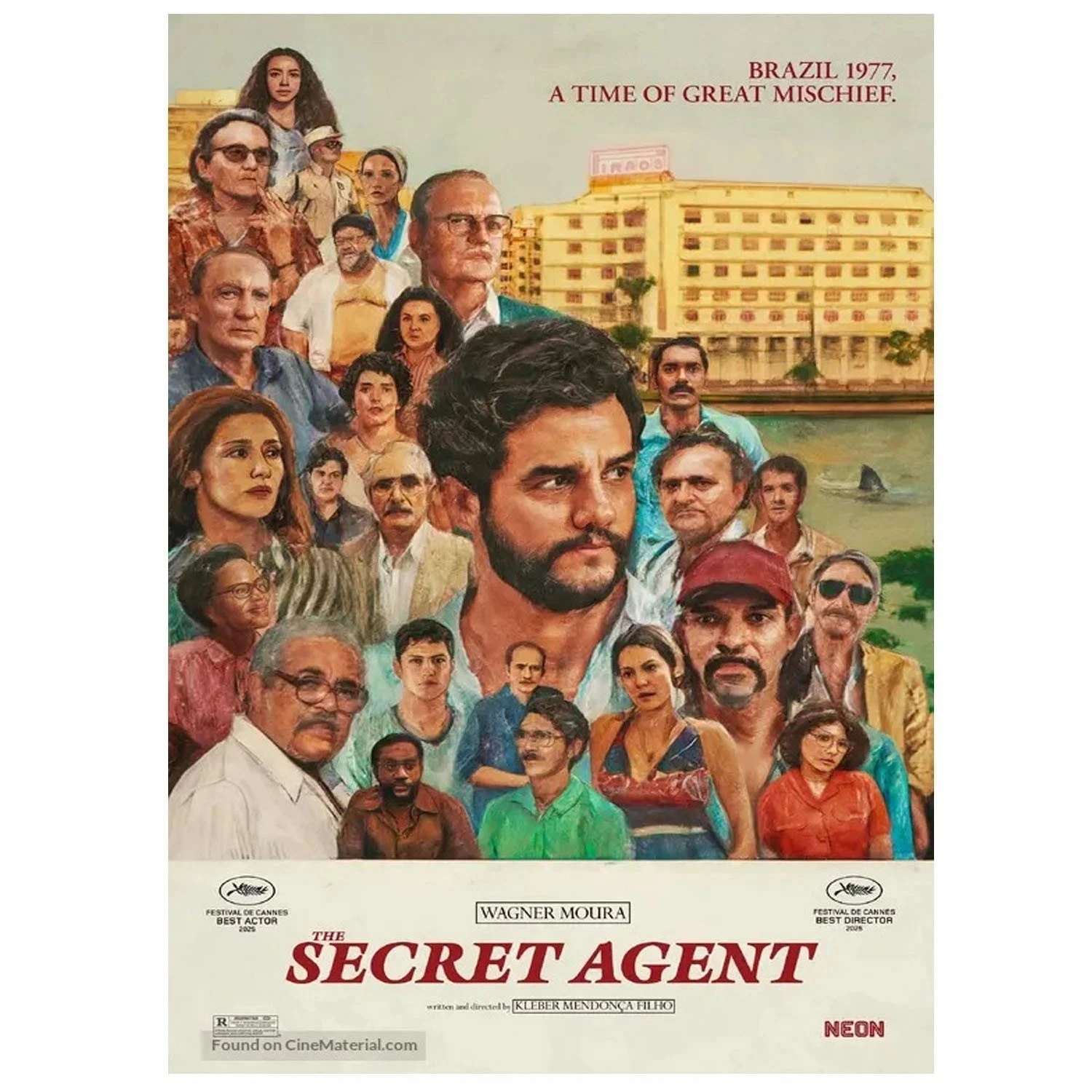
The Secret Agent is a Brazilian based movie generating lots of buzz in all the right circles. The Director is Kleber Mendonca- not a household name in the United States, but a filmmaker with a distinguished track record. He was born in Recife, Brazil in 1968 and took an unconventional path to moviemaking. He worked as a journalist, then spent years as a prominent film critic before deciding to take a shot at directing his own films. He immediately established himself as a serious player. Neighbouring Sounds (2012) placed on the New York Times Ten Best List. Aquarius (2016) competed for the Palme d’Or at Cannes and Baccaru (2019) won the Cannes Jury Prize. Secret Agent has built on that legacy. It swept the key awards at Cannes in 2025- Best Director, Best Actor for Wagner Moura and the Art House Cinema Award. It also won Critic’s Prizes in Los Angeles, New York and the National Society of Film Critics. It was recently nominated for Oscars in the Best Picture, Best Actor, Best Casting and Best International Film categories. I always attempt to see the Best Picture nominees before the awards program and I watched this film with an open mind- particularly since I was underwhelmed by One Battle After Another and Sinners. I give a qualified “thumbs up” to The Secret Agent.
Amalia and I visited Brazil in 1981, four years after this film is set. Our experience left an impression that has never faded. The diversity, sensuality and sheer complexity of the country were overwhelming- beauty and the beast on every corner, the most colourfully dressed people we had ever seen and an underlying uneasiness that political intrigue was just around the corner. We did not feel entirely safe. Mendonca captures this environment completely. What struck us then and what the film confirms is that Brazil under the dictatorship was not a police state in the style of Eastern Europe. Instead, it was a society of extraordinary vitality with carnival celebrations and artistic passions sharing the same streets with corruption, menace and brutality.
Recife itself is a character in the film. It is not as well know as Rio or San Paolo, but is actually Brazil’s fourth largest city. It is situated at the northeastern tip of South America and has always carved out its own identity. It is ultra cosmopolitan with African, Italian, indigenous, Portuguese, Dutch and Jewish roots creating a colourful mosaic. Its carnival is distinct from Rio’s, rooted in Afro- Brazilian rhythms and an outrageous street parade culture. Geographically remote from the Rio- Sao Paolo axis that dominates Brazilian cultural life, Recife has also nurtured a tradition of political radicalism that made it a target of suspicion and oppression during the years of the military dictatorship. All of these elements come to life in the film.
The narrative is straightforward. 1977 is year 13 of the military dictatorship. The main character- Armando- is a former university engineering professor whose cutting edge research was stolen by a racist right wing industrialist with strong ties to the government. The flashback that reveals their conflict is powerful. Armando’s research department is shutdown, his wife is murdered and Armando, sensing he is next on the “kill list” goes underground. His life on the run and then as a anonymous resident (he is now Marcello) of Recife drives the plot. He arrives during Carnival to reconnect with his young son Fernando- who has lived there with in laws since the death of his mother. His plan is to flee the country with his son - relying on the assistance of locals actively opposed to the government.
The cast of characters surrounding Armando- Marcello is the strongest component of the film. Armando takes refuge with Dona Sebastina (Tania Maria), a magnificent septuagenarian whose apartment has become a safe house for the dispossessed. We meet political dissidents, a married couple who have fled the Angolan Civil War, a Jewish Holocaust survivor and a divorced woman fleeing an abusive ex husband. Together, they form a mosaic of 20th Century victims and survivors. They are likeable souls- even noble. They are simple people who possess both character and courage. Armando has special bonding moments with his son. He romances the divorcee and takes a job as a clerk at the Department of Identification. Meanwhile, the city buzzes with its own surreal energy: a tiger shark has been caught with a human leg in its stomach. We meet a cat with two faces. We see the bodies of political activists thrown into the sea. It is lawless! A contract has been placed on Armando’s life by his ex nemesis who now holds a major position in the government. We meet the two hitmen and a local subcontracted assassin. A corrupt and grotesque police chief floats in and out of the narrative- a manipulator who operates with a casual brutality. The movie is not a promotion piece for the Brazilian political authorities.
One thread that puzzles the audience (me) is Armando’s search for his mother’s identification papers. He eventually learns from a relative that his mother was a 14 year old servant girl. Armando is self assured, not a lost soul and I wondered why the Director pursued this plot line. It is a distraction from the main drama. I think that Mendonca is making a political statement about the nature of Brazilian culture. Beneath the surface of even the most confident Brazilian citizen lies a history of colonial exploitation and racial violence that the state has never documented or acknowledged. There is no accountability for horrible crimes. Armando’s mother did not exist if you relied on the records- she is one of the disappeared- she was powerless and authoritarian regimes specialise in abusing the weak and destroying any evidence of misdeeds.
The movie is uneven. I loved the first thirty minutes and the last thirty minutes. The middle meanders to the point of artistic self indulgence by the Director. The introduction has great cinematography and music- we hear Chicago and Donna Summer on the car radio. We feel the late 70’s. The colors are vivid and the interactions between Armando and the authorities are tense- brilliantly presented. The quirky characters arrive in waves and they draw you into their exotic worlds. Tania Maria- who plays the chain smoking Dona Sebastiana- deserves every award in sight for her performance. She is a very old women who has outlasted lovers, regimes and betrayals and who has maintained her dignity and her core values through all of it. Wagner Moura’s Armando is a man of intelligence and warmth who has been stripped of everything, but vigorously holds on to the love of his son. He is focused on survival and he has a complicated internal life. Unfortunately, the middle of the movie is populated by side plots. Attacks on gay men in a park, the farcical investigation into the death of the man whose legs has ended up in the stomach of a shark- the reanimated leg coming alive and bouncing across the city. I am sure a poignant metaphor is Mendonca’s intent here, but I don’t get it. It also makes the movie unbearably long and a bold editor could easily have cut 30 minutes without losing the essential idea of the film.
Luckily, the final act more than compensates for some of the movie’s weaknesses. Now, we meet a young female historian (Flavia) who has spent years listening to audio from police surveillance tapes from the dictatorship years. There, she encounters Armando and his story. She tracks his Recife experience and learns of his eventual killing by the hired government assassin. She is mesmerised by Armando’s journey and seeks to close the circle by interviewing his son Fernando- now a physician in Recife in his late 20’s. Fernando reluctantly agrees to the interview. When confronted by the wealth of evidence gathered by Flavia, he admits he has no memories of his father. He has not retained anything from Armando’s 1977 interlude in Recife and doesn’t he remember the sound of his voice. She gives him the recordings and suggests he may get to know his father now. Fernando is uncertain and makes no commitments. Armando, like his wife and mother has been erased- but perhaps now he can be rediscovered. Fernando, and Brazilian society generally, need to decide whether they want to abandon their almost blissful absence of memory regarding the dark times of thirty years prior. Ambitious filmmaking!
My verdict- a B+ with qualifications. There is visual splendour, thematic richness, outstanding performances and a genuine moral weight to Mendoncas cinematic project. It may not be a great movie, but it is worthy of your time. All artistic efforts that remind us of the dangers of autocracy and corruption are valuable educational exercises in today’s toxic environment.