There is a particular kind of afternoon that only the magic of Rome can produce. You walk into a palace or church, sometimes planned, sometimes not- the light is good, the streets are crowded, the entry door is open- and an hour later you emerge a changed person. You are genuinely moved by the experience. Magnificent works of art displayed in centuries old settings highlight that our world is a very special place. You reflect on the world and your place in it. At their best, a brilliant work of art triggers a spasm intellectual curiosity. Who were the men and women that created the magic and what do we know about the times they lived in. I experienced this rather existential phenomena three separate times this spring.
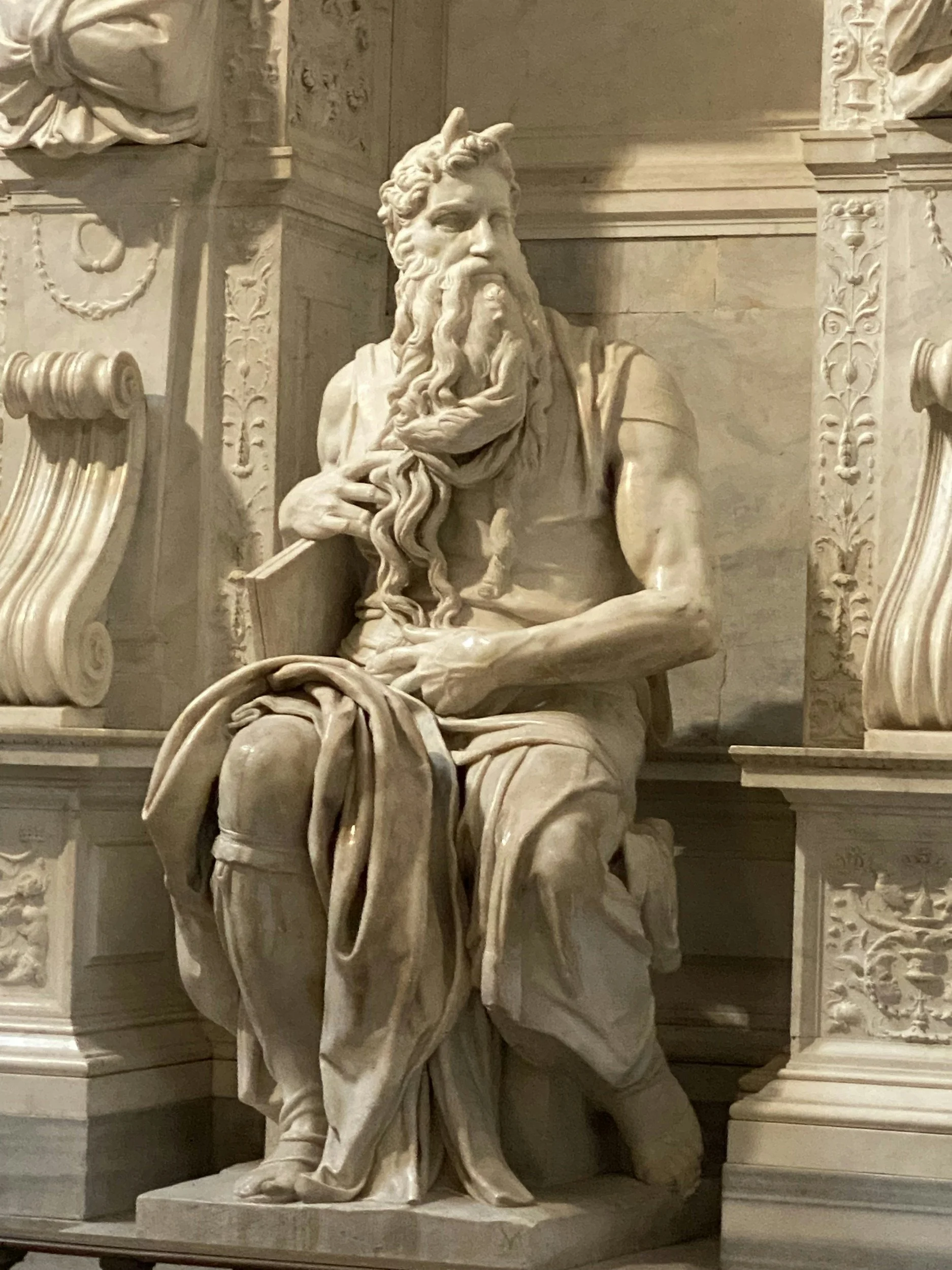
The first visit was to Santa Maria della Vittoria, home to Bernini’s Cornaro Chapel and its center piece, the Ecstasy of Saint Teresa. The second was to San Pietro in Vincoli, on the Esquiline Hill, where Michelangelo’s gigantic “Moses” sculpture sits in all its glory. The third occasion was the comprehensive Bernini exhibition currently running at the Palazzo Barberini- a superb collection of his sculptures, drawings and portraits. These outstanding sojourns confirmed that I was due for a serious and sustained return engagement with the Renaissance. How did a volatile and fascinating world produce such first class creators? What were the artist’s core character traits and what motivated their patrons and sponsors? What follows is not a conventional art review. It is a reflection of what great art does when it energises our mind and spirit. Art goes beyond the mere aesthetic. It directs us to an examination of history, biography and politics. Our research here revealed an amazing spectacle of human ambition and human failure. The three visits were inspirational - opening up opportunities for me to do a deeper dive into the Renaissance. Let’s look at Pope Julius, Michelangelo and Bernini- each who played a huge role in the Renaissance explosion of culture.
Julius II was the “Warrior Pope.” You cannot stand before the “Moses”, a sculpture he commissioned and hired Michelangelo to execute, without acknowledging that Pope Julius, born Guiliano della Rovere in 1443 is a major historical figure. He reigned as Pope from 1503 to 1513. He earned the nickname “Il Papa Terribile” from his contemporaries. He personally led Papal armies into battle. He used nepotism without apology, won his Papal election thru bribery and harboured one of the great personal vendettas of the Renaissance. He hated the Borgia family, particularly Pope Alexander VI, his predecessor as Pope. The Spanish born Borgias had basically purchased the Papacy in 1492. After the election of Alexander, Cardinal della Rovere spent ten years in France- a self imposed exile from Rome. He denounced the Borgia Pope regularly and plotted his revenge against the entire family. When Alexander died in 1503 and Julius won the Papacy, the revenge was immediate. He declared that Borgia “had desecrated the Holy Church as none before” and proclaimed that no church official should ever speak the Borgia name again. He closed the apartments where Alexander had slept. The Borgias faded from history, although there outrageous behaviour continues to fascinate writers and producers to this day.
Pope Julius was also a man who took the vow of celibacy as a suggestion rather than an obligation. He fathered at least one illegitimate daughter, possibly three more- rotated thru mistresses and faced down Church Council charges of “lewd sexual acts” in 1511. BUT, this was also the man who recruited and mentored Michelangelo, Raphael and Bramante. Pope Julius transformed Rome into the artistic capital of the Western world. The contradiction is not incidental. It is the Renaissance in miniature. Towering achievement and ambition coexisting with spectacular vice and hypocrisy. What a picture Rome and the Catholic Church presented to the wider world in the late 15th and early 16th century.
Our next stop is Michelangelo, Pope Julius favourite artist and punching bag. He is a true genius. Michelangelo Buonarroti lived 88 years and spent most of them burning with creative intensity and an odd emotional isolation. He slept in his clothes, accumulated a fortune while living like poor man and was a man who withdrew himself from society, His domestic habits were “incredibly squalid” and he had an awful temper. Historians agree that his deepest emotional attachments were to men, not women. He never married. He wrote over 300 poems, the longest sequence to a young Roman nobleman 25 years his junior. The poems are unmistakably passionate. His nephew, publishing them posthumously, changed the male pronouns to female. Michelangelo fought a lifetime spiritual war with his own desires- deeply Catholic convinced that his longings were sinful. He channeled his energy into stone and frescoes.
The “Moses” at Santa Maria della Vittoria was considered by Michelangelo himself to be his finest work. It it so vivid and lifelike that Michelangelo himself asked “why don’t you speak to me?” “Moses” is the survivor of what art historians call the “tragedy of the tomb.” Our friend Pope Julius commissioned a freestanding monument that would stand above on his tomb at the delle Rovere family church. Basically an awesome tribute to himself. Quite an ego!! He hired Michelangelo, but kept diverting him to other projects, including the Sistine Chapel ceiling. It took Michelangelo 40 years to finish the sculpture. At completion in 1545, Pope Julius was long gone, having died in 1513. Julius was buried in St Peter’s so the ”Moses“ today stands on its own at Santa Maria della Vittoria. It is magnificent. Visit this rather modest appearing church on your next visit to the Eternal City.
Gian Lorenzo Bernini is our next subject. He was Michelangelo’s temperamental opposite. Where Michelangelo was solitary and ascetic, Bernini was as smooth as silk. He was very social, politically adroit and handsome. His self portraits, of which there are many (another healthy ego), show dark eyes and a face that radiates confidence. This magnetic genius had a dark side though. He was capable of jealousy and savagery and the exhibit at Palazzo Barberini captures the duality in his character.
“The Ecstasy of Saint Teresa” at Santa Pietro in Vincoli is a work that elicits a silent awe from visitors. Teresa of Avila had described a vision in which an angel pierced her heart with a golden lance, leaving her in a mesmerised state. Bernini rendered the event in white Carrara marble. Teresa is floating on a cloud, head thrown back, mouth parted, the angel above her smiling with serenity and golden rods descending from the heavens. A story has long circulated that the work was rejected by the Vatican because it was too “sensual.” Respected historians reject this argument and records show Bernini had been hired for a private commission by Cardinal Cornaro and this was the Cardinal’s home church. However, the sculpture could be deemed provocative to the strait laced and a widely distributed pamphlet in 1670 condemned the work for making “a pure virgin into a Venus, not only prostrate, but prostituted.” For me, Santa Teresa is breathtaking and Bernini competes with Michelangelo for the title of “Best Sculptor if All Time.”
As hinted above, Bernini had a complicated personal life that casts a shadow over his reputation. In the mid 1630’s, while producing some of the most spiritually elevated art in the Catholic tradition, he was conducting a clandestine affair with Costanza Bonarelli, the young wife of one of his workshop assistants. He carved her bust, now in Florence’s Bargello Museum, with startling intimacy. Her hair is disheveled, her robe loosely open- clearly a woman in a post rapturous moment. He kept the work in his private rooms so he was clearly enamoured with the lovely Costanza. Unfortunately, Bernini’s brother Luigi was also having an affair with the energetic young lady. Bernini discovered the truth and went ballistic. He attacked Luigi with a crowbar and Luigi only avoided death because he escaped to the sanctuary of Santa Maria Maggiore Church. Bernini then instructed his most trustworthy servant to deliver Costanza a “gift”- a violent attack on her beautiful face with Bernini’s own razor. OUCH! Justice, Renaissance style, followed in due course. Costanza was imprisoned on adultery charges, Luigi was exiled to the Italian countryside. Bernini was fined but payment was waived by a Papal Decree. The Pope instructed Bernini to clean up his act and get married immediately. Bernini complied, fathered 11 children and seemed to have a happy marital union. His career flourished. As a fun fact, Costanza was eventually released from prison and she became a successful art dealer in Rome and outlived Bernini.
We have come a long way from my three joyous spring visits to Roman churches and palaces. There are fascinating lessons here. There are interesting patterns. The Catholic Church of the Renaissance was powerful. It was also corrupt and Martin Luther soon made his appearance and the Reformation bloomed. The Catholic Church, on paper, had rigid rules on human sexuality. Clergy were celibate, sodomy was condemned and marital fidelity was sacred. However, the most powerful Popes of the era kept mistresses and fathered illegitimate children. The greatest artist almost certainly was gay and wrote loves poems that his family felt compelled to falsify. The supreme Baroque artist, confidant to multiple Popes, ordered a woman’s face destroyed in a jealous rage and was essentially forgiven by lunchtime. None of this diminishes the beauty to he art- the Moses is no less extraordinary because the Pope was a hypocrite. The Ecstasy of Saint Teresa is no less transcendent because its creator was a philanderer capable of violence. The Renaissance Church produced it s greatest art from men who exempted themselves from its fundamental moral teachings. Certainly, a graphic contradiction, but we must accept that great beauty can arise from imperfect hands. I continue to debate what is the coolest part of Roman history- Ancient Rome or the Renaissance. My investigation will continue.