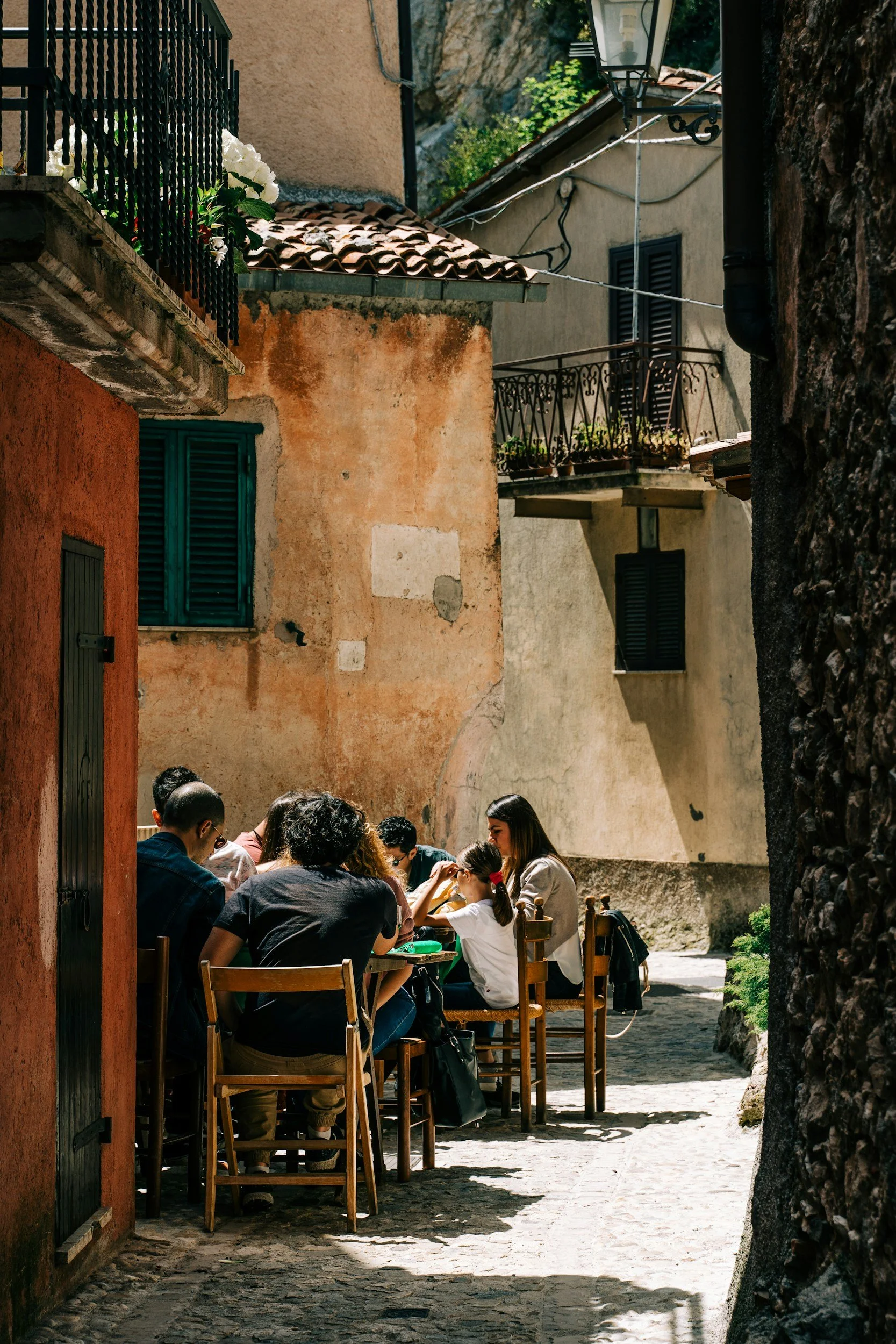
Growing up in Chicago, I noticed a pattern with the Italian families in my neighbourhood that only came into focus for me years later. My Italian friends’ fathers almost all had small business- grocery stores, barbershops, tailors, contractors, restaurants. Frequently, they were family operations with the immediate and extended family members all playing a role. The Irish families, by contrast, were attracted overwhelmingly toward large institutions: the police department, the fire department, the unions, political ward organisations and the Catholic Church. Both were tight knit immigrant communities with strong loyalties and a fierce sense of identity, but the Irish were comfortable with the shelter of strong and existing organisations while the Italian families instinctively built their own silos. After years of deliberation, I developed a theory. The Italian immigrant experience in the United States was not accidental or sui generis. Instead, it reflected a value system deeply embed in Italian culture- a disposition that stretches from Ancient Rome to the modern fashion runways in Milan and from the Renaissance Papacy to the boardrooms of Fiat. Identifying that value system animates this entire series of essays. Eventually, we will opine on the Top Ten Noble Families of Renaissance and Baroque Rome- establishing a Circle of Honour and a Circle of Shame. Prominent Italian families are very INTERESTING and they played an enormous role in creating the historic mosaic you encounter in a visit to Italy today.
Basic thesis! The organising principle of Italian civilisation, going back 2500 years, is the family. Not the state, not the Church, not the community, not the corporation- though all of these played important roles at various times, but the family. To understand Italy in any era, you must recognise that the primary unit of loyalty, economic organisation, political action and social identity is the family unit. To understand the major Renaissance families, you must embrace the deep cultural logic that produced them. They expressed the concept of “La Famiglia” in its purest form.
Roman civilisation built the family into its legal and political architecture from the beginning. The “familia” was the foundational unit of classical era Roman law. The “Paterfamilias” held absolute authority over spouses, children, dependents and slaves. A Roman man’s family name- his “nomen”- was his most important credential, announcing his lineage, his alliances and political affiliations. The great “Gentes” of ancient and imperial Rome were not just families, but political brands sustained across generations through carefully managed marriages, adoptions and alliances. The Julian-Claudian emperors were essentially a family business that ruled an empire. At the outset, imperial succession was family matter and that concept held firm for centuries. Julius Caesar’s daughter was married to Pompey to seal their political partnership and her early death dissolved the personal bonds and ultimately contributed to civil war. The Gracchi brothers pursued their radical land reforms as a family project. When Tiberius was murdered, Gaius picked up the torch. Their ideas did not survive the demise of the family line.
If anything, the centrality of the family became even more important in the Medieval, Renaissance and Baroque eras. The collapse of the central imperial authority made the family role even more critical. In the vacuum created by the absence of reliable institutions, the family provided what the state could not: physical protection and security, credit, legal advocacy, political connections and a social standing. The great medieval dynasties- The Viscount and Sforza of Milan, the Este of Ferrara, the Malatesta of Rimini- ran their territories a family businesses. The Estes governed Ferrara for 600 years. The Florentine banking families- Bardi, Strozzi, Pazzi, Peruzzi were explicitly family firms, with branch managers drawn from extended kinship networks with trust based on bloodlines rather than contracts. The Medicis perfected the formula.
The Renaissance Papacy is the most extreme and dramatic expression of this family centric logic. The highest position in the Catholic Church, theoretically built on a God given universal spiritual authority became an unapologetic center of family aggrandizement and profiteering. Every Renaissance family you meet in this series used the Papacy as a vehicle for dynastic family advancement. They were not subtle. Nepotism was not a corrupting element of the system- it was the system. The title “Cardinal Nephew- Cardinal Nipote” was recognised as an official role. The Pope’s favourite nephew was expected to manage the family’s interests in the Roman Curia with the full weight of Papal authority and power behind him. The logic was impeccable by Italian standards: an unrelated Cardinal may defect, be bribed or pursue an independent course. A nephew was bound by blood, dependent on the Pope’s favour and his fortunes rose and fell with the family’s. When Sixtus IV made six of his nephews Cardinals, when Paul III appointed his 14 year old grandson to high office and when Alexander VI ran the Vatican as a Borgia family enrichment project- these decisions were not viewed as aberrations. The protagonists were operating under basic Italian family principles; they were acting in accordance with those values at the highest levels of powers and in the most shameless way. The lessons were passed down to succeeding generations.
Let’s move forward from Popes and Cardinals to Godfathers and Consigliere. The 19th and 20th century organised crime familles of Sicily and southern Italy are the darkest expression of the same cultural logic. The Mafia emerged as a response to the chronic failure of Italian state institutions in Italy to provide security, justice or contract enforcement, the same vacuum that had made the family essential in ancient Rome and the Renaissance. Into this void, the “cosca”, the family network- provided what he state could not. The Cosa Nostra chieftain was a “paterfamilias“ authority figure and loyalty was the supreme value. The system was based on kinship and bloodlines and betrayal of the family was the ultimate crime. The Sicilian Mafia’s “Five Families” in New York- Gambino, Genovese, Lucchese, Columbo and Bonnano were all explicitly organised as family structures- supplemented by quasi kinship members who took an oath of loyalty to the family. Broader association with the community was discouraged, seen as a distraction from the main purpose of the organization- the protection of the family. Remember the famous scene in Godfather I when Michael Corleone (Al Pacino) tells his brother that he is joining the US Army to fight in WWII. Sonny, played beautifully by James Caan, goes ballistic and tells Michael that fighting for your country is “for suckers.” Only family matters!
Mario Puzo nailed the paradigm perfectly. He reportedly researched the Medici family history before writing the novel. Marlon Brando as the Godfather is a secular Pope Paul II, a man of great ability and institutional ruthlessness. The Godfather is a tale about a family business and the Corleone family internal dynamics- succession, loyalty and the tension between the patriarch’s vision and the son’s characters- mirrors the the Renaissance Papal dynasties with an uncomfortable, almost creepy precision. The parallel is real.
Modern Italy, from Ferrari to Gucci, graphically reflects the identical principles. Italian capitalism remains distinctively family oriented. Corporations have their place, but the family is the only unit that can be trusted and trust is the most important driver in building a successful enterprise. Ferrari’s public profile and emotional identity in building the most powerful brand in motor sport is inseparable from Enzo Ferrari’s family story. Fiat has been controlled by the Agnelli family for over a century. Giovanni Agnelli, the “Avvocato,” was Italy’s most powerful; businessman for a generation and his grandson chairs the Stellantis empire today. Prada is run by Miuccia Prada, the grandaughter of the founder, with family creative control central to the brand’s identity. Versace passed from Gianni to his sister Donnatella after his murder. The family name is the company’s entire marketing strategy. Ferragamo, Bulgari, Barilla, Luxottica - Italy’s most celebrated commercial names are almost universally family enterprises that have prospered across multiple generations. We even have intra and inter family disputes that mirror the intrigues of the Renaissance. The Gucci family, after building tremendous wealth, was destroyed by family warfare which culminated in a hit man appearing a the Milan family headquarters. The violent rivalries mirror the Renaissance and Baroque era family battles between the Borgias, the della Rovere, the Colonna and the Orsini. Family feuds with staying power, lasting for centuries. Family giveth and family taketh away!
Our upcoming series on the noble families of Rome explores this principe at its most consequential, frequently dramatic. The families who built Renaissance Rome and sponsored the world’s greatest artists were not doing so as individuals or abstract patrons of the arts. They were doing so as ambitious families, building a dynastic identity, projecting family power and securing family legacy. They aggressively competed with rival families for resources, prestige and the spiritual authority and political power represented by the Papacy. The nepotism is brazen and the vendettas were long and brutal. Family honour was paramount and the art was magnificent because it was the the best way to validate and enshrine family greatness. The families are inseparable from the art. Understanding one requires understanding the other. You viewing experience will be enriched if you know the story of the major players of the age. Our essays will identify the “Top Ten” (remember I like lists), provide biographical background, trace their historical contributions, identify the key sites in Rome reflecting their legacy and also muse on how they are captured in popular culture. A wonderful project for me and I hike through Rome with my intellectual curiosity intact.