Spotlight on Books: WFM’S All Time Best: CRIME AND PUNISHMENT by Fyodor Dostoevsky
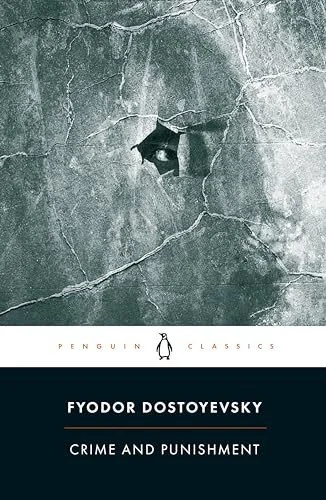
Fyodor Dostoevsky was born in Moscow in 1821. His father was a military physician. Fyodor originally trained as an engineer, but abandoned that career for literature. His first novel Poor Folk made him an overnight sensation in St Petersburg literary circles. He then experienced a reversal of fortune. In 1849, Dostoevsky was arrested for participating in the Petrashevsky Circle, a group of intellectuals who read and debated banned western texts and utopian socialist ideas. He was sentenced to death for his revolutionary thinking. In December of that year, he and his fellow conspirators were marched into St Petersburg Square, tied to post and made to stand before a firing squad. At the last possible moment, a rider arrived with a reprieve from the Tsar. The entire execution had been staged as a psychological punishment. Dostoevsky’s sentence was commuted to four years hard labor in a Siberian prison camp, followed by years of forced military service. A hard road for a privileged young man.
This was the hinge of his life. He emerged from Siberia with his youthful socialism shattered and replaced it with a deepened Russian Orthodox faith, a suspicion of political systems and a clinical fascination with the psychology of guilt, suffering and redemption. Out of this transformation came a series of great novels: Notes from Underground (1864), Crime and Punishment (1866), The Idiot (1869), Demons (1872), and The Brothers Karamazov (1880). He is now regarded, along with Tolstoy, as one of the towering figures in Russian literature. His influence was wide, impacting Nietzsche, Freud, existentialism and 20th century theology.
Dostoevsky wrote in an violent and unstable environment. Russia was hurtling toward catastrophe. Serfdom had been abolished in 1861. The empire was flooded with radical ideas imported from the west. Modernism was colliding with a society that had been raised on Orthodox faith and Slavophile pride. The Tsar government was entrenched in its autocratic ways and was circling the wagons. St Petersburg was a city of enormous and disorienting inequality. Grand imperial architecture towered over neighbourhoods of slum housing, violent taverns and crooked pawnshops. This was the world Dostoevsky puts under a microscope in ‘Crime and Punishment.”
The novel follows Rodion Raskolnikov, a destitute former law student living in a cramped and filthy St Petersburg flat. In isolation, he develops his own “superman” theory that certain chosen and gifted men are entitled to transgress ordinary law and morality in service of a greater good. Napoleon is his model. To test his theory and to relieve his own poverty, he intentionally murders a loathsome and exploitative pawnbroker. In a moment of panic, he also kills an innocent sister of the original victim. The rest of the novel is not your standard criminal “whodunit”, but an unrelenting examination of what the murder does to Raskolnikov’s mind. He is pursued less by the police than his own conscience. He interacts with the police investigator Petrovich, his devoted sister Dunya, his loyal friend Razumikhin and the young prostitute Sonya. Together, they pull him back into the real world and he embarks on a path of suffering, confession and spiritual rebirth.
I honestly don’t remember if I first read Crime and Punishment in a class or simply picked it up on my own. What I do remember vividly is I was mesmerised and told everyone in my orbit that they had to read it. It remains for me the most intense examination of human psychology I have encountered on the written page. It is a book of incredible turmoil and incredible depth. What made it so different is that we are inside Rasolnikov’s head, not watching him from the outside. Dostoevsky doesn’t just narrate a crime and its aftermath. He simulates a mind, one that is justifying, doubting and unraveling in real time. He makes the theory that the truly extraordinary person is exempt from moral rules seductive. It was recognisable and I could feel its pull even as the novel was systematically destroying it. Dostoevsky does not make it easy for the reader because the targeted pawnbroker is a genuinely awful human being dedicated to exploiting the desperate poor an unfortunate. We also see that Sonya has been driven to prostitution by unjust societal circumstances. Conventional morality looks hypocritical. Why not bend the rules? Maybe nihilism is superior to religiosity and spirituality. I responded to how seriously Dostoevsky portrayed the dangers of intellectual arrogance and pride. I also was moved by his warnings on how social inequality and social isolation can distort an unfocused mind. Raskolnikov spends much of the novel cut off from real human contact, fuming in his room, turning dangerous ideas over and over in his head without anyone around to argue with him. It strikes me now that Raskolnikov would be at home today, sixteen hours deep into social media and video games, experiencing the same isolation in modern clothes.
The book is not only an indictment of a crazy philosophy. It is bleak and dark, but also posited the possibility of redemption. Sonya was at the moral center of Raskolnikov’s journey. She was forced into prostitution to keep her family from starving. She carries that shame without being crushed by it. Her faith is holding her life together. She is given depth by Dostoevsky. Sonya is more interesting and complex than the fallen women with a heart of gold stereotype. When Raskolnikov finally confesses the murder to her, he fears her reaction more than the police. She doesn’t lecture him, doesn’t recoil and refuses to offer cheap comfort or forgiveness. Instead, she tells him to kneel and confess to the authorities and the people he has wronged.
In addition to Sonya, there is Porfirio Petrovich, the police investigator. What a fascinating character! He knows that he is short of hard evidence but understands that Raskolnikov’s own conscience is doing his work for him. He simply waits and needles and let’s Raskolnikov’s mind reach the conclusion that his theory is nonsense and he must be punished for the murders. Raskolnikov’s mother and sister love him without qualification and Raskolnikov recognises that he is unworthy of their devotion unless he does the right thing. Razumikhin is decent and unglamorous, a living rebuke to the idea that only extraordinary men matter. Finally, there is the sheer physical and psychological toll; the fevers, the ravings and the inability to eat or sleep. The body tells the mind what needs to be done to preserve your sanity. Finally, Dostoevsky is subtle. Raskolnikov does confess but that is only step one to genuine repentance. It is only in the epilogue, in the Siberian prison camp, with Sonya having followed him, that something approaching true remorse starts to break open in him. Dostoevsky is not sentimental and he makes Raskolnikov struggle with redemption
I loved the writing itself; the realism, the interior monologues and the dark claustrophobia of St Petersburg. Others have told me they found the prose dense going; I never did. To me, it was polished, urgent, almost feverish in its intensity and pacing. I also loved the novel’s ambition. It is about big things and Dostoevsky handles it all without a trace of frivolity. It is about individual choice, moral freedom, psychological fragility, the demands of social justice, the role of religion and the duality of the human character. Intimidating! I also read several of Dostoevsky’s other novels and they are all quite compelling but Crime and Punishment remains his home run for me.