LEOPOLDSTADT (Theater)
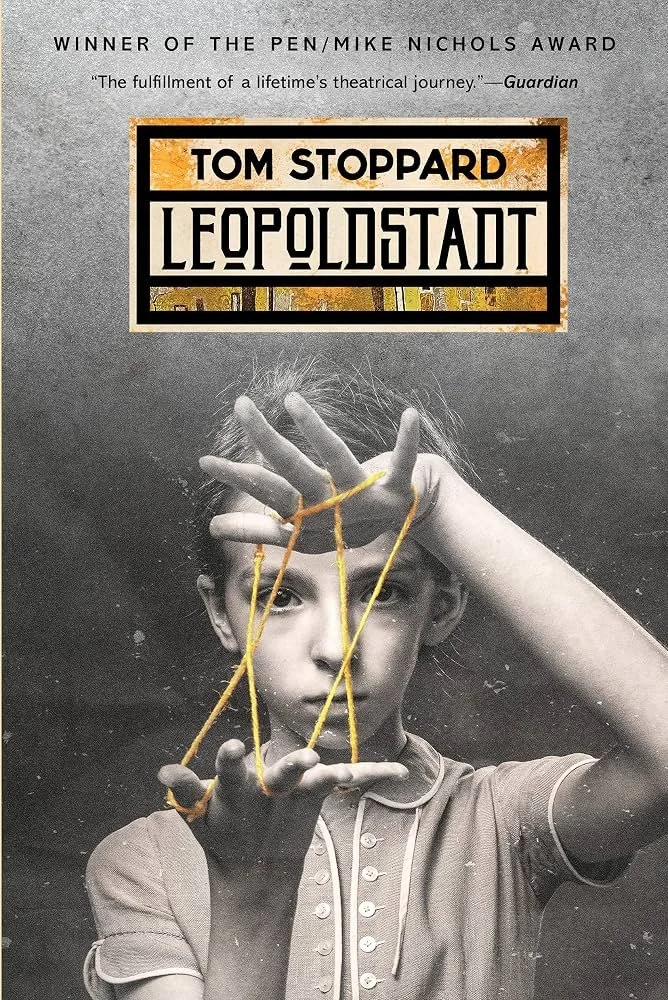
Renowned playwright Tom Stoppard’s final play- LEOPOLDSTADT- is now playing at Writer’s Theatre in Glencoe, Illinois. Since we elected to spend our summers on our original home turf, we jumped at the opportunity to see the production last weekend. It was a special experience, beautifully written, perfectly cast and a captivating and sobering story. The play is extraordinarily ambitious, running nearly three hours, featuring 27 characters and spanning four generations of Jewish family life in the late 19th and early 20th century Vienna. Stoppard describes the family’s complicated and painful history through episodes and events that occur in 1899, 1900, 1924, 1938 and 1955. His prose is vintage Stoppard, elegant and intellectual and depicts the gradual fracturing and destruction of a complex family confronting the excesses and insanity of the era. It is also noteworthy because Stoppard has openly stated that events in the play are quasi-autobiographical. Seeing this work now was particularly compelling for me because I recently wrote a review of Stefan Zweig’s classic autobiography The World of Yesterday, classifying it as one of the books that significantly impacted my thinking and attitudes as a young man. Zweig was also Jewish, born in Vienna and the the world described by these two brilliant authors is eerily similar and frightening. Both, using different mediums, are eulogies for a world that was changed radically by World War I and then destroyed completely by Nazism, Fascism and the World War II.
First, a word about Writer’s Theatre, a company worthy of presenting Stoppard’s weighty work. Writer’s Theatre opened in 1992 in the back rooms of a Glencoe bookstore. It has earned an amazing reputation over the past 35 years and has built a legacy of artistic and creative success. It is widely recognised in theatre circles for bold choices, risk taking and a commitment to excellence. I confess a personal bias and interest here since I served on the Board for six years and Amalia and I have been long term subscribers and financial supporters. With good reason, if I say so myself. The Wall Street Journal called it America’s finest regional theatre company and in 2016 it won the Regional Theatre Tony Award, an honour extended to only a handful of companies outside New York. Its theatre home since 2016, designed by Jeanne Gang’s Studio Gang Architect is a marvelous space and has won a host of architectural honours. Earlier Writer’s productions, including Crime and Punishment and Minister’s Wife moved to New York. Therefore the decision to stage Leopoldstadt, its largest production ever, was a logical next step in the theatre’s creative journey.
Stoppard is famous, but a bullet point biography is necessary here. He was born Tomas Strausser to Jewish parents in 1937 in Ziin, Czechoslovakia. His family fled when the Nazis marched into Czechoslovakia - first to Singapore and then to India. His father was killed in Singapore in a Japanese bombing raid. His widowed mother then married a British Army Major, Kenneth Stoppard, who gave young Tomas his English name and, in effect, his British life. Stoppard said his mother was always extremely vague about the family background and he did not learn of his Jewish heritage until a cousin told him in 1993. He was in his 50’s, one of the most celebrated playwrights in the english language when he first discovered that all four of his grandparents had been murdered in Nazi concentration camps. This reality sat with him for decades and it wasn’t until Leopoldstadt premiered in London in 2020 that he directly engaged with this material. He deliberately framed the story with an invented Viennese family rather than a Czech one modeled on his own. He stated “quite of lot of it is very personal to me, but I made it about a Viennese family so it wouldn’t seem to be solely about me.” The distinction is rather thin and Stoppard admitted before his death that the play is unmistakably autobiographical. The final scene in the play definitely captures Stoppard’s own experience when he learned he was Jewish and that his family had died in the Holocaust genocide. Listening to his language becomes even more rewarding as an audience member when you know the background. Intense- tough stuff! Leopoldstadt was an enormous critical and commercial success on release. The London production won the Olivier Award for Best New Play. It arrived on Broadway in 2022 and won the 2023 Tony for Best Play.
The play is a history lesson. Leopoldstadt takes its title from Vienna’s traditional segregated Jewish district, although none of the action actually occurs there. Instead, from Scene One onward, we meet the extended Merz family living in a grand apartment off the Ringstrasse in the heart of assimilated and prosperous Vienna. The Jews had been subject to a horrible history of pogroms, discrimination and persecution in Christian dominated Europe for hundreds of years. But, as the 20th century approached, things were looking up. Emperor Franz Josef had lifted the legal barriers to full Jewish participation in civil, political and professional life in 1884. The doors of Vienna opened to the Jews and they immediately made enormous progress- prospering economically, entering the professions, succeeding in academia and playing active leadership roles in an artistic and cultural institutions. By 1900, on the face of it, there had never been a better time to be of Jewish heritage and living in Europe. Leopoldstadt is only invoked in the play with faint social embarrassment- the old quarter that the thriving family had been fortunate enough to leave behind. Unfortunately, as we all know, things do fall apart and the play artfully shows how and why.
Five scenes span 1899 to 1955, always in the same room. In 1899, we see the extended Merz and Jakobovicz families gather for Christmas, decorating a tree, singing, giving gifts to children, debating Freud, Klimt and Herzl. They are self assured and entirely at ease with the families success. By 1900, an affair exposes the limits of their assimilation in Viennese society, By 1924, WWI has maimed and radicalised the younger generation and the family fortunes are fraying under Austria’s post war chaos and political angst. The empire was gone! By 1938, it is Kristallnacht and the family is evicted from the apartment it has occupied for two generations. By 1955, three descendants meet in the same room, now emptied of furniture and warmth, to reckon who among their relations is alive and who is not. A sad tale.
Stoppard build the narrative through distinctive characters who each embody a response to the curse of anti semitism. He does not let any single character embody “the Jewish” response to Vienna and Europe’s madness. Instead, he crafts a small ecosystem of strategic responses and let’s each proceed on its own terms. We learn there was no magic answers and the ambiguity is constant throughout the play. Here are the primary players and what they represent. I will try not to give too much away since many of you have not seen the play- but should!!
Herman Merz, the patriarch, has pursued Jewish assimilation to its logical extreme. He converted to Catholicism. married a gentile Gretl and built a family structure built on wealth, culture and legal ingenuity. He is a proud fellow- “my grandfather wore a caftan, my father went to the opera in a top hat and now I have the divas to dinner.” He is genuinely convinced the ascent in society is permanent. He gradually learns otherwise. He demands satisfaction from upper class Army officer Fritz after an insult, but discovers a Jewish born man, however decorated or converted, still does not qualify as a gentleman and doesn’t merit a duel. It is the play’s first proof that the wager he has placed on progress may be worthless. He is eventually forced back into Leopoldstadt and takes his own life at the last seder the family holds together.
Gretl, his wife is a glamorous symbol of betrayal and the fragility of the whole social arrangement. Her Klimt portrait hangs in the family living room and disappears after Kristallnacht. By 1955, we learn that it is now hanging in Belvedere Museum in Vienna. No compensation- no post war justice- contemporary Austria is undisturbed by how the painting got there and is comfortable absorbing this object of theft as legitimate cultural patrimony. Gretl’s affair with Fritz does save her son Jacob. Herman convinces Fritz to falsely claim Jacob as his son and Jacob survives the war because he is classified as a gentile.
Ludwig Jakobovicz, Hermann’s brother in law is the play’s skeptic, a gifted mathematician whose career at university is being quietly blocked by the anti-semitism that Hermann insists is fading. It is Ludwig who raises Herzl’s Zionist manifesto “Judenstaat” in the opening scene. Hermann dismisses it “why trade Vienna for a state built in the desert” - one that is built on the absurd premise that Jews can not survive anywhere else.” Stoppard, to his credit doesn’t write the exchange as a debate between a naive assimilationist and a prophetic Zionist. It is simply an intellectual disagreement between two serious people reading identical evidence and reading opposite conclusions.
The women carry the play’s quieter moments. Eva, Hermann’s sister and Ludwig’s wife is the domestic glue between the families. Wilma, Ludwig’s sister is the play’s historian, sitting over the family photo albums. Hannah represents Jewish love of the arts fostered in Vienna, but remains unmarried and ornamental. Grandma Emilia is the classy old world matriarch and she is unsentimental and unconverted, delivering hilarious digs at the “Papists” now sitting at the family dining table. She is a natural skeptic, never buys into anyone’s forecast for the future and prefers to trust memory and tradition.
Ernst, Wilma’s Protestant husband is a physician and an early admirer of Freud. He wears a yarmulke at the seder out of love rather than belief. He faces some tough decisions as the Nazis assume power and Stoppard uses him as a vehicle to pose a hard question: What does a good gentile do when confronted with evil and what moral obligation does he owe to those under attack? Jacob is the son of Hermann and Gretl. He is wounded in WWI and describes himself in 1924 as “a one eyed, one armed cradle Catholic of Jewish descent- those are my politics.” He is a cynic. He survives the Holocaust, protected by the legal fiction Hermann created that he is illegitimate and therefore not Jewish. We learn in the final scene that he commits suicide after the war has ended. Stoppard suggests it is motivated by guilt. A truly wrenching character. Finally, Fritz, the aristocratic officer who has the affair with Gretl is worth pondering even though is role is small. He is handsome, charming, sophisticated but still holds Hermann as a converted Jew in contempt. From his perspective, Jews can never really be admitted into polite society. His soft anti semitism laid the foundation for the more extreme steps the Nazis embarked upon later. Otto, the family banker is interesting and Percy Chamberlain, the British journalist who spirits Nellie and her young son Leo away to England is also a subtly attractive character. He is a clear eyed witness, sees where things are going, a representative of the sane west that acted too late. His surname saves a child though.
One final character deserves his own paragraph. Leo is Nellie’s son who is taken by Chamberlain to safety in England in 1938. He is Stoppard’s unmistakeable self portrait. He is raised English, treats his own Jewishness as “an exotic fact” until “cousins” Nathan and Rosa force him to reckon with a history and legacy he had been encouraged to forget. It is a rather unflattering portrait. Leo isn’t merely innocent when conversing with his Holocaust survivor relative. He is callow, glib and uncurious and is instinctively resistant when Nathan tells him he lives “as if without history, as if you throw no shadow behind you.” Stoppard renders a harsh verdict on himself and the play can be interpreted as a good faith effort to close the circle and remedy a wrong. Well done indeed!
There is much more we could reflect on here, but I like to keep my entries disciplined length wise. The play does touch on Zionism and Israel, but Stoppard is neutral in his presentation. It would have been easy for Stoppard to write Nathan a speech in the closing scene that simply states that Herzl and the Zionists were right and that assimilation was a fantasy that doomed the family. Instead, Nathan’s great speech is not a black and white vindication of Zionism. He only mentions Herzl once, re-marking that his tomb has been moved to Jerusalem. Enraged rather than complacent, he defends the Jews claims on Vienna. After all, they built much of it- the doctors, lawyers, architects, composers and artists who made it a world class city. He states “Who are they to tell me I am not wanted?” Stoppard is arguing, even after Auschwitz that the sense of belonging to Western culture was real and legitimate, not an illusion. Palestine was never viewed as realistic option for successful European Jews in the 30’s. The Jews who dominated Vienna could not imagine themselves anywhere else- it was their home.
Finally, the play really has no heroes. It is simply a tragedy. No single choice, whether it be conversion, marriage, money, cultural engagement- turns out to be a reliable or safe hedge against catastrophe. The tragedy isn’t caused by the main characters fatal flaw. The evil here isn’t a person but a culture that collapsed. I did not find the ending cathartic. Rosa’s recitation of the names of the dead and how they died is not a solemn remembrance. It certainly isn’t justice. It is a hardhearted ledger- a final scorecard on human folly. The ending is not aggressively hopeful either.
I respect this play enormously and recommend it without reservation. However, a slight curveball is heading your way. Despite my fascination with Stoppard’s skill and the narrative itself, the play did not capture me emotionally. Several of my friends described it in ecstatic terms- a life changing theatre experience. I did not have the same reaction. I think the play’s structure and its intellectual strength undermine its emotional force. The size of the cast and the density of ideas in every scene keeps you slightly detached even as tragedy accumulates. For me, it is not “Doubt” which achieves emotional devastation in 90 minutes with four characters and never lets you look away. It is not Hamilton which was a “high” for me based on its sheer theatrical momentum. It is not A Man for all Seasons which finds its power in a single man’s clarity of conscience. It is not Wolf Hall which was two full evenings of brains and heart. Leopolstadt is a wonderful experience. It is intelligent and humane, but it did not reorder the way I look at this messy world. Go and see it for yourself and decide where you think it belongs in the pantheon of great plays.