Mark Twain- American Oracle and Global Superstar
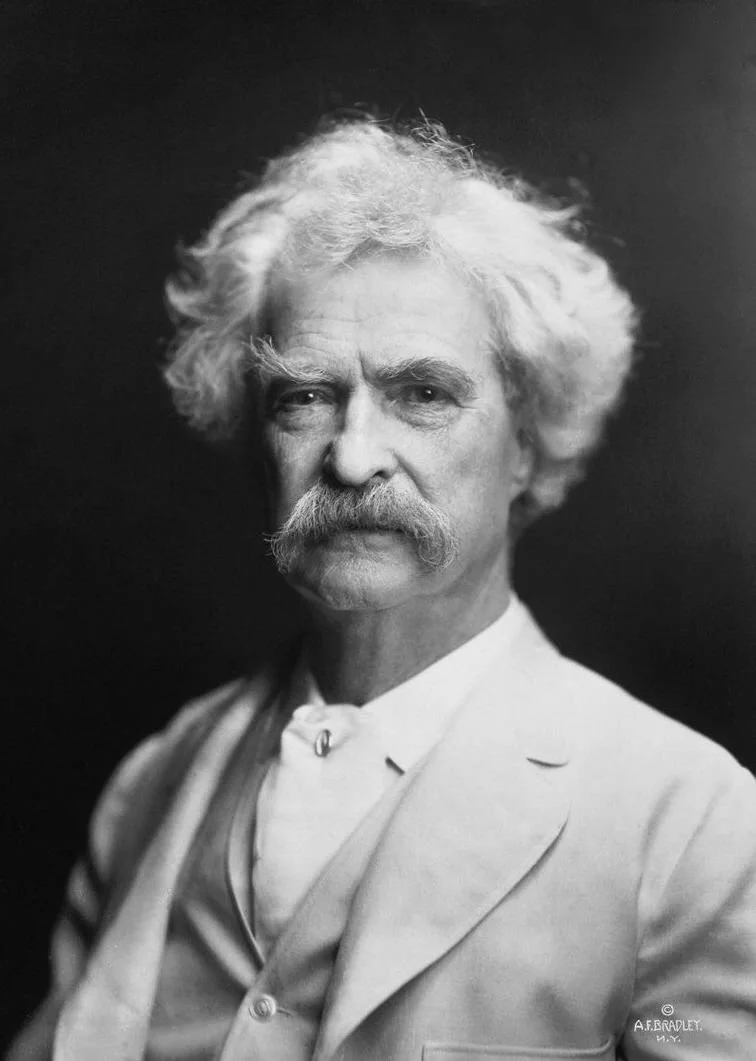
By A.F. Bradley, New York - steamboattimes.com, Public Domain, https://commons.wikimedia.org/w/index.php?curid=11351079
Samuel Clemens emerged from the banks of the Mississippi River and ultimately traveled to every corner of the earth. In the process, he became Mark Twain, the white suited oracle of American identity. No American writer has embodied such striking contradictions: the provincial who became cosmopolitan, the humorist who turned prophet, the democrat who loved aristocrats, the anti imperialist who befriended empire builders, the family man haunted by family tragedy and a moralist who was fascinated by money. To understand Twain, you must accept these tensions wholeheartedly. Otherwise, you will miss the big picture and undervalue his significance as a true American icon.
I recently finished Ron Chernow’s recent biography- exhausting at over 1000 pages but providing the raw material for understanding this complex man. Chernow is super thorough and would have benefited from more aggressive editing, but his research illuminates the public Twain and the private Clemons. This is a man who became an international figure but who struggled with the demons of debt, grief and an increasingly dark view of human nature. What emerges is a man more interesting than the genial and biting humorist of public imagination. Instead, we see a man of incredible literary talent, a man of genuine moral courage but also a man of troubling limitations and human foibles. His story actually reads like the great American novel he plays aspired to, but never quite executed. The man is Shakespearean!!
Twain’s domestic life was an American Odyssey. It was a journey of wide geographic scope- coast to coast, but also a narrative on American culture, class and race. His travels gave him a range of experiences no drawing room novelist could match. Born in 1835 in Florida, Missouri and raised in Hannibal, he knew poverty firsthand. His father’s death when Samuel was 11 ended any dreams of formal education. He became a printer’s apprentice, then a journeyman wandering from town to town, absorbing the rhythms and idiom of common American speech that would later revolutionise American literature. He then became a Mississippi riverboat pilot and was quite good at it. The river was America in microcosm- North and South, commerce and nature, capital and labor, freedom and slavery all flowing together. Piloting brought him into contact with every class of American society. He received an education in democracy and also chose his pen name- Mark Twain. His roughhouse education then proceeded with gritty work in Nevada silver mining camps and his first opportunity as a newspaper journalist in San Francisco. He saw violence, confidence men, fraudsters and genuine entrepreneurs. He was mentored by good writers. He saw fortunes made during the day and lost over nite. He developed a skeptical eye toward humanity which would serve him well later as a writer and social critic.
The next chapter introduced him to a different world. He went east, fell in love and was defined by his marriage, literary success and the manners of upscale Hartford. He lived with his wife and family for 17 years in an extraordinary mansion, a Gothic extravaganza that cost a fortune to build and more to maintain. Here was the unsophisticated boy from Hannibal living in luxury, employing servants, hosting literary dinners and meeting and charming the rich and famous. Quite a social leap! However, Twain never fully shed his frontier origins. His Hartford study mirrored a riverboat pilothouse. His greatest books looked backward to his Missouri boyhood, not Gilded Age sophistication. He ultimately ended up in New York, completing the journey from country boy to metro sophisticate. He held court on 5th Avenue. Finally, his knowledge of America was enriched by the multiple nationwide lecture tours he embarked on every 5 years or so. He needed to pay the bills. No region of the country escaped a Twain visit- the man even traversed to Hawaii and Alaska, decades before they were admitted to the union.
Twain then became the First Global American. He would have been a Davos Man today! He became a celebrity. Twain became famous worldwide by being unmistakably American. He didn’t apologise for American roughness or try to acquire European polish. Europeans fell in love with him because he represented something new and fresh- an unfiltered and witty voice from the New World. He lived in Europe for almost 15 years. His extended residencies in Europe weren’t exile but adventure and necessity. Financial pressures and his wife Livy’s health sent the family abroad repeatedly, spending years in Germany, Italy, Austria, England and France. Twain lectured in Paris, dined with the German elite, held court in Viennese cafes and was received by the Prince of Wales. When Oxford awarded him an honorary doctorate in 1907, he treasured the scarlet robes and wore them at every opportunity- the Hannibal boy who never finished school accepting Honors from the world’s most prestigious university. He supplemented his European experience with a worldwide lecture tour in 1895 and 1896 where he visited Australia, New Zealand, India and South Africa. The purpose was to payoff crushing debts from failed business ventures but it made him famous in places that had never heard of most American writers. He became that modern phenomenon: a global celebrity, recognised everywhere and his opinions sought on every topic.
Twain showed moral courage on the issues of race and imperialism His essay “The United States of Lyncherdom” condemned the epidemic of lynching with moral clarity, identifying mob racial violence as America’s shame. The Spanish American War and the American occupation of the Philippines appalled him and he joined the Anti-Imperial League. In “To the Person Sitting In the Darkness”, he savaged Western imperialism with barely controlled fury. Yet these progressive positions coexisted with troubling limitations. His letters and published writings sometimes deploy racist language indistinguishable from a white supremacist southerner. He ridiculed the savagery of Native American Indians throughout his life. He had a paternalistic view toward indigenous peoples in third world countries and openly stated that India could not survive without British governance. To a certain extent he was a “Man of his Times” warts and all. The contradictions extended to class and wealth. Twain critiqued Gilded Age robber barons and championed democratic values while living in luxury and befriending the plutocrats he satirised. His best friend was Henry Rogers of Standard Oil and he broke bread with JP Morgan and Andrew Carnegie. He loved playing billiards with captains of industry while denouncing the system that created their fortunes. Was this hypocrisy! Perhaps, but a moral critic requires a platform and platforms usually aren’t available to individuals who completely alienate the power structure. Twain successfully navigated both worlds.
Twain also had a complicated relationship with organised religion- he had the instincts of an infidel which was a risky position to take in “Christian” America. He was raised Presbyterian in Hannibal and absorbed enough Bible to quote it directly in lectures, but he was erratic in his church attendance. He wrote to his friend Joseph Twichell, a Hartford Minster, “If Jesus were here now, there is one thing he would not be- a Christian.” The remark captures Twain’s distinction between Jesus’s teachings which he admired and institutional Christianity which he despised. His major works targeted religious hypocrisy. In Huckleberry Finn, pious citizens are enthusiastic and brutal slaveowners. A Connecticut Yankee in King Arthur’s Court depicts medieval Catholic priests as ignorant exploiters keeping their flock in superstition ridden bondage. Family tragedies pushed his skepticism toward outright atheism. Basically he asked- what kind of God could be so cruel! In The War Prayer he imagines congregants praying for military victory in unsparing language: “O Lord our God, help us tear their soldiers to bloody shreds with our shells… help us to wring the hearts of their unoffending widows with unavailing grief.” TOUGH STUFF!
The white suit and genial public persona obscured how politically dangerous Twain became as he aged. He became a radical, willing to attack powerful institutions, challenge popular prejudices and risk his reputation on unpopular causes. He spoke out forcefully against anti- semitism when such bigotry was socially acceptable in polite American society. He hated the Russian empire and the Czarist autocracy. He despised its hereditary privilege, its religious fanaticism and its purposeful crushing of human freedom. He aligned himself with reformers and revolutionaries when it was not politically popular. Twain didn’t care about diplomatic niceties or geopolitical calculations. He called out tyranny in a very public way. His moral outrage extends to King Leopold’s brutal exploitation of the Congo. At a time when European colonialism was largely accepted or politely ignored, Twain joined the Congo Reform Association and wrote scathingly about the Belgian monarch’s atrocities. Attacking a European sovereign for crimes against Africans risked alienating his literary audience. Twain argued for international human rights standards; the principle that sovereignty didn’t grant license for brutality and that the powerless had inalienable rights that need to be protected. He articulated the framework for the post WWII universal human rights regime. He was ahead of his time.
Twain as private and family man experienced more than his fair share of tragedy. Although a high profile public persona, he was shaped and ultimately broken by domestic life. His marriage to Olivia Langdon was genuinely loving. Livy came from a affluent and refined New York family and served as his anchor, editor and censor. She smoothed his path to respectability and acceptance in high society. She softened his prose, discouraged his more savage impulses and worried constantly about his reputation and their finances. The couple had four children, one a son who died in infancy. Twain was a devoted father to his three daughters, but the relationships were complicated. He was frequently absent - on lecture tours or conducting business. There was pressure to maintain appearances and an expensive lifestyle. Sadly, family tragedy came in waves. Suzy, the brilliant eldest daughter (probably lesbian) died of meningitis at the age of 24 while Twain was abroad. Twain never fully recovered. Jean suffered from severe epilepsy and died on Christmas Eve in her bathtub in 1909. Clara survived to old age but was chronically depressed and was in and out of sanitariums much of her life. Livy was a semi invalid for much of the marriage and died in 1904. Twain was bereft, felt guilty and became bitter. The Clemons home was perpetually shadowed by sickness, treatments, quack doctors and the accumulation of medical catastrophes darkened his world view. Twain himself suffered from painful gout and was in pain almost all of the time. His later writings descended into a philosophical pessimism- light years away from the light and comedic touch of his early years. He also engaged in very strange behaviour with adolescent girls- creating an “Angelfish Club.” Here, he cultivated relationships with girls ages 10-16 by exchanging correspondence, giving gifts and dining together. There is no hard evidence of predatory behaviour but it was odd, creepy and strange even by the standards of the time.
The final piece of the Twain character puzzle is his relationship with money and the financial chaos he created when he touched any business venture. Staying a pure and starving artist was not his ambition. His least attractive trait was his obsession with money. He had disastrous judgment in money matters and was extraordinarily litigious. He was an artist of rare genius who spent enormous energy and resources on get rich schemes, nearly all of which failed spectacularly. The most disastrous was his investment in the Paige typesetting machine which Twain believed would dominate the publishing industry. He invested 9 million in current dollars and it failed miserably- forcing Twain into a humiliating bankruptcy. He and the family were forced into European exile. To his credit, he eventually paid off all his creditors, but it was an exhausting process. Twain also feuded with his publishers and business partners incessantly. He was a one man grievance machine who always thought he was being cheated and he destroyed many relationships with his pettiness and distrust. Not an appealing fellow in this arena- not at all!
We will discuss Twain’s literary legacy in a second essay. I think it is important to understand the essence of his character. To me, he is more than a great American writer; he is an American original, an icon who is a quintessential symbol of the American spirit. His contradictions are America’s contradictions. He celebrated American possibility while exposing American hypocrisy. Twain can’t be claimed by any particular ideology, because he was complex, inconsistent and often contradictory. He was a self made man who made it big- a globally recognised artist, sage and celebrity. He rose from poverty through talent and hustle. He traveled the world while never forgetting the lessons of the Mississippi and seemed to love humanity while never forgetting its pretensions. He is an indispensable oracle, a source of wisdom and still relevant to the continuing American experiment. Read Chernow’s biography - just plan on it consuming your entire summer of beach reading!