THE ODYSSEY: Directed by Christopher Nolan
A thought provoking inquiry among friends is “Who would you invite to a dinner party if there were no rules or historical limitations?” What combination of extraordinarily gifted and accomplished people would generate the most illuminating and fun exchange of ideas, particularly if the food and wine is first class? I just saw The Odyssey at the theatre and have decided that Homer and Christopher Nolan would get a seat at my next party. 2800 years of the human experience separate them, but I would love to hear why they believe Odysseus's journey home from Troy is a tale worth telling. Is there a universal message? Is it a teaching moment or just a wildly entertaining adventure? Let’s do a quick biographical review.
The “facts” about Homer are hotly contested by classicists and historians. We don’t even know whether he was a genuine person or just a name attached to a long oral tradition. Ancient sources disagree on his birthplace, his dates and even whether he was blind. What does survive are the works published under his name, specifically The Iliad and The Odyssey. And what a legacy! They are widely recognised as the core foundation of Western literature and culture. They, along with the Bible, have been required reading for generations of students. The Odyssey is 12,000 lines of poetry and a meditation on war, morality, identity and homecoming. It embraces “journey” narrative that was adopted later by Virgil, Dante, Tennyson and James Joyce. I think he would be a fascinating guest. Let’s assume that he has watched the last 2800 years from a comfortable perch in heaven. I want to know whether he is proud of The Odyssey because his treatment of heroism and justice has stood the test of time. I want to know whether he intended Achilles rage as tragedy or indictment and whether Odyseus’s cunning was meant to be admired or distrusted. I would also tell him he would have made a lot of money in the contemporary world as a psychiatrist.
Christopher Nolan was born in London in 1970 to an English father and American mother. Nolan broke through with Memento in 2000 and then built a career on large scale and structurally ambitious films. Serious moviegoers are familiar with The Dark Knight, Inception, Interstellar, Dunkirk and Oppenheimer. He is the Director who every “A” list actor or actress in Hollywood wants to work with and he received the Best Director Oscar for Oppenheimer. He would be an argumentative guest. He is a very confident fellow who sees himself as a contemporary Homer. He has long believed that popular films can carry the same weight as literature and that spectacle and seriousness can coexist. I would ask him why he cut certain episodes in Homer’s poem from the movie. Homer and Nolan could joust - the man who invented the story and the man who convinced himself it was worth adapting to the screen 2800 years later. As we discuss in a moment, I believe the dinner party repartee would probably be a more productive use of three hours than the movie itself.
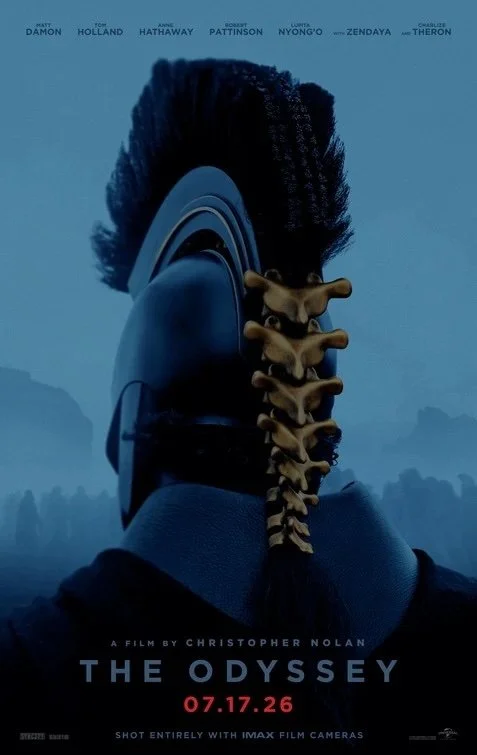
The movie cost 250 million dollars and early reports confirm the investment was recouped in a week. It was shot in Italy, Greece, Morocco, Iceland and Scotland. It is the first feature shot entirely on 70 mm IMAX cameras. The cast is big time: Matt Damon, Anne Hathaway, Charlize Theron, Zendaya, Tom Holland, Robert Pattinson, Samantha Morton, Lupita Nyong, John Leguizamo, Jon Bernthal and Elliot Page. The initial critical reception was strong, but there were dissenters and skeptics. The Guardian’s Peter Bradshaw praised “its thrilling ambition, boldness, seriousness, generosity and flair.” NPR called it “thrilling but uneven” with a final act of classical simplicity. Time concluded that it was an “eye-glazing dud.” Anecdotal reviews from friends and family are disparate in the extreme with many loving it and a significant minority wondering what all the fuss is about. I have also observed demographic differences with younger men the most enthusiastic about Nolan’s technique and the entire production.
My own assessment is mixed. There are aspects that work. First, it is an extraordinarily ambitious film. Nolan is unapologetically pursuing epic and blockbuster status. So an “A” for effort. The last 30 minutes, Odysseus’s return to Ithaca, are genuinely moving and exceptionally well crafted. The best balance of action, depth and suspense. The Trojan War flashback is electric, fast paced and unflinchingly brutal. The Circe pig transformation is creepy and mesmerising. Cyclops, the giants, Charybdis are vivid and compelling. On pure craft, there is much to admire here.
I also believe some of the louder public criticisms are overstated. The modern American colloquial dialogue does not offend me. Where is it written that all classical Greek and Roman characters must speak with an Oxford trained British accent. On the casting controversy over Lupita Nyong as Helen, specifically Elon Musk’s diatribe that “Nolan has sold out and gone woke” I would say that Musk is inane and potentially insane. Matt Damon, of Irish and Scandinavian ancestry doesn’t look especially Greek either. The actual problem with Nyongo’s casting is not her race but she is completely underutilised. These are sideshow observations and distractions that don’t impact the ultimate merits of the film.
I do have significant issues with the movie. It never captured me emotionally. I found it hollow. I liked Damon but I never truly invested in his fate. This is a fundamental problem for a film that is entirely about whether a man gets home. The screenplay is very weak. I am not referring to the use of the modern vernacular, a stylistic choice I defended above. Instead, it is that he writing is thin, simplistic, featuring high school level dialogue with no great lines, dialogues or speeches. There is no humour or irony. It is flat. This is strange because Homer’s Odysseus was cunning and witty. The soundtrack compounds the problem. It is frequently deafening and the dialogue frequently disappears under the din. This sharpens my sense that Nolan is substituting volume and scale at the expense of interior life and psychological complexity. The weak dialogue also undermines character development. The female cast members are universally gorgeous, but they are severely underwritten. Penelope, Helen, Athena and Calypso could be on “X” based on the overwhelming number of cliches they are forced to utter in this script. This does lend some support to a broader and recurring criticism of Nolan that he doesn’t write dynamic female characters. One memorable line would have been nice!
Casting choices were also questionable. Tom Holland is underwhelming as Telemachus. Robert Pattinson is too young, too smooth and too American male to project the depth and menace surrounding Homer’s Antinous . Anne Hathaway’s Penelope has a modern feminist gloss. She is basically her Devil Wears Prada character on vacation in Ancient Greece rather than a woman with the depth to match her husband’s cunning and patience. The one female performance that actually lands is Samantha Morton’s Circe and she is a witch. She is allowed to be strange, dangerous and interesting rather than simply beautiful or noble. 8 years with Charlize Theron on a Greek island was not hard duty, but Calypso is somehow a bit boring here. John Leguizamo is great as Eumaeus, a character of courage, loyalty and quite dignity
Odysseus is the central figure in the film and Damon is game. Nolan seeks to give him complexity. He is a brilliant warrior, the hero of Troy, devoted to his family and kingdom but who is intelligent enough to register the weight of what he has done. He knows he has deceived and destroyed a great civilisation and for what! It has a modern sensibility and I am not confident the original Odysseus carried the same self awareness. There is also an underlying incongruity in Odysseus. He is in a hurry to get home but take the most circuitous and hazardous route possible. He is brilliant leader but his entire crew ends up dead and all his ships are lost. The film is also surprisingly prudish. Family man Odysseus spent a full year sleeping with Circe and 8 years cuddling with Calypso in the poem but here sex and lust have left the building. Nolan has the same instinct in the treatment of the suitors deaths in Ithaca. Homer has Odysseus hanging all the household women who slept with the suitors, a brutal and morally troubling act that Nolan underplays and ignores. Perhaps Nolan doesn’t think modern audiences can handle complex heroes after all!
I also question some of Nolan’s editing choices. He omitted Odysseus’ exchange with Achilles in Hades which I always believed was the most important exchange in the poem. Achilles says he would rather be a living slave than the King of the Dead and my teachers presented that quote as Homer’s challenge to the worship of heroic glory. I would also have kept the visit to Scheria with its enlightened King and its magical ships. It would be a reminder that the world isn’t just avoiding monsters but also embracing goodness. After all, they were the reason Odysseus actually made it home in Homer’s original work. Of course, the movie would have been another 45 minutes with these additions so perhaps I am being unfair.
My problem goes deeper than omitted scenes. The set piece episodes are excellent filming on their own. Cyclops, pigs, sirens, giants, whirlpools all had me thinking at the time, “What a cool scene”; But for me they didn’t construct a compelling narrative. They had me thinking that Nolan was just checking enough boxes to assert that he had been loyal and faithful to the original text. Overall, a decidedly mixed bag. Genuine technical achievement, an ending that nearly redeems the whole but not a movie I will rush back to see again.